Showing 12 of 12 items
50 Items
Sort by:
Featured

Alpine W10S4 10" Subwoofer
- 250 Watts RMS | 750 Watts Peak
- 4-Ohm
- Polypropylene and Mica Cone
Hide Details
Show Details
Hide Details
Show Details
Alpine W10S4 10" Subwoofer - 4 Ohm Alpine knows that bass is essential for car...

Alpine S2-W10D4 S-Series 10” Subwoofer
- 600 Watts RMS | 1800 Watts Peak
- Dual 4-Ohm Voice Coils
- Carbon Fiber/Polypropylene Cone
Hide Details
Show Details
Hide Details
Show Details
Alpine W10S4 10" S-Series Subwoofer - 4 Ohm Alpine knows that bass is essential for...

JL Audio 10TW3-D4 10 Inch Subwoofer Driver
- Very shallow mounting depth (3.25 / 3.50 Inches)
- No pole vent: permits mounting close to rear wall of enclosure.
- Very small sealed enclosure volume requirements
Hide Details
Show Details
Hide Details
Show Details
10TW3-D4 TW3 10-inch Subwoofer Driver (400 W, dual 4 Ω voice coils) Building on the...

Kicker 48CWRT102 CompRT 10" 400 Watt Dual Voice Coil Subwoofer - 2 Ohm
- Solokon cone system w/ 360 degree bracing
- Ribbed Santoprene Surround
- Forced Air Cooling 20% Cooler
In stock
Hide Details
Show Details
Hide Details
Show Details
Kicker 48CWRT102 CompRT 10" 400 Watt Dual Voice Coil Subwoofer - 2 Ohm The CompRT...

JL Audio 10W3v3-4 10" Subwoofer
- 500 Watts RMS
- 4-Ohm
- Mineral-Filled Polypropylene Cone
Available for Shipping Only
Hide Details
Show Details
Hide Details
Show Details
JL Audio 10W3v3-4 10" Subwoofer - 4 Ohm This acclaimed subwoofer driver strikes an outstanding...

JL Audio 10W6v3-D4 W6v3 10" Subwoofer
JL Audio 10W6v3-D4 W6v3 10" Subwoofer
If you are seeking to reproduce the highest quality sub-bass in a very compact enclosure application, the 10W6v3 is the ultimate choice. This advanced subwoofer driver offers several technologies shared with the flagship W7AE subwoofers to provide powerful advantages in motor linearity and suspension behavior. These combine with a very efficient cooling circuit to deliver reduced distortion and outstanding dynamic balance. The 10W6v3 is best used with amplifier power in the 200W - 600W range and is optimized to operate in a sealed enclosure with only 0.55 cu. ft. (15.6 l) of air space. Detailed enclosure recommendations can be found in the "Specifications" tab.
Greater excursion capability and higher power handling distinguish it from our 10W3v3 10-inch subwoofer driver, allowing for higher output. Dual 4 Ω voice coils permit deploying the W6v3 as a 2 Ω or 8 Ω driver.
General Specifications
Continuous Power Handling (RMS): 600 Watts
Recommended RMS Amplifier Power: 200 - 600 Watts
Nominal Impedance (Znom): Dual 4 Ohm
Physical Specifications
Nominal Diameter 10.0 in / 250 mm
Overall Diameter (A) 10.5 in / 267 mm
Mounting Hole Diameter (B) 9.02 in / 229 mm
Bolt Hole Circle (C) 9.86 in / 250 mm
Magnet Diameter (D) 6.3 in / 160 mm
Required Pole Vent Clearance 0.50 in / 13 mm
Mounting Depth (E) 6.89 in / 175 mm
Driver Displacement 0.078 cu ft / 2.1 L
Net Weight 20 lb / 9.1 kg
Parameters
Free Air Resonance (Fs) 30.12 Hz
Electrical “Q” (Qes) 0.543
Mechanical “Q” (Qms) 9.228
Total Speaker “Q” (Qts) 0.513
Equivalent Compliance (Vas) 0.821 cu ft / 23.25 L
One-Way Linear Excursion (Xmax)* 0.75 in / 19 mm
Reference Efficiency (no) 0.1100%
Efficiency (1 W / 1 m)** 82.7 dB SPL
Effective Piston Area (Sd) 49.303 sq in / 0.0318 sq m
DC Resistance (Re)*** 6.452 Ω
* Xmax specifications are derived via one-way voice coil overhang method with no correction factors applied.
** For parallel-wired voice coils, divide "Re" by 4. All other specifications remain the same.
*** Re (DC resistance) is measured with the voice coils in series, for parallel-wired specification divide Re by 4. All other specifications remain the same.
Out of stock
Hide Details
Show Details
Hide Details
Show Details
JL Audio 10W6v3-D4 W6v3 10" Subwoofer If you are seeking to reproduce the highest quality...

KICKER 44CWCS104 CompC 10" 500 Watt Subwoofer - 4 Ohm
KICKER 44CWCS104 CompC 10" 500 Watt Subwoofer - 4 Ohm
Features Signature StitchesOur signature yellow stitching creates a superior bond between the tough, ribbed polyurethane surround and polypropylene cone for the best in reliability.
 Poly Perfection
CompC subwoofers have a lightweight, injection-molded polypropylene cone to eliminate flex and distortion. You get a deep, accurate sound no matter how hard you push it. Stay Cool
Perimeter venting slots allow air to constantly circulate around the motor to maintain the perfect operating temperature. You Make It Bump
With recommended power ratings as high as 600 watts, this KICKER sub delivers serious bass! Use a CX amplifier for the perfect marriage of power and performance. 10" CompC 4 Ohm SVC
CompC Subwoofers are equipped with stamped steel frame construction, inheriting elite innovations for world-class KICKER power, durability and hard-hitting, high-performance bass. Features:
- Four-Ohm Voice Coil
- Injection-Molded Polypropylene Cone
- Perimeter Venting for Thermal Management
- Ribbed Polyurethane Surround
- Signature Yellow Surround Stitching
- High-Strength Spiralead™ Tinsel Leads
- Stamped Steel Basket
- High Temp Voice Coil
- Spring-Loaded Speaker Terminals

Specifications
- Size (IN.,CM) 10, 25
- Impedance (OHMS) 4 SVC
- Max Rec Amplifier Power (WATTS PEAK/RMS)* 600/300
- Sensitivity (dB 1w/1m) 86.2
- Frequency Response (Hz) 30-500
- Mounting Depth (in, cm) 4-13/16, 12.2
- Mounting Cutout (in, cm) 9-1/8, 23.1
- Min Sealed Box Vol (cu. ft, L) 1.0, 28.3
- Max Sealed Box Vol (cu. ft, L) 2.4, 68
- Min Vented Box Vol (cu. ft, L) 1.25, 35.4
- Max Vented Box Vol (cu. ft, L) 1.75, 49.6
Out of stock
Hide Details
Show Details
Hide Details
Show Details
KICKER 44CWCS104 CompC 10" 500 Watt Subwoofer - 4 Ohm Features Signature StitchesOur signature yellow...

Kicker 45L7R102 10" L7 Series Dual Voice Coil Subwoofer - 2 Ohm
Kicker 45L7R102 10" L7 Series Dual Voice Coil Subwoofer - 2 Ohm
BIG BASS SOLO-BARIC 10" SQUARE SOLUTION Our square subs deliver more cone area. That means we deliver more bass, yet require no more air space than a standard round sub. Features- Dual two-Ohm Voice Coil
- Wrap Around Gasketing
- Patented Ribbed Corners
- Injection-Molded SoloKon™ Woofer
- 360-Degree Back Bracing
- UniPlate™ Back Plate And Pole Piece
- Bumped Back Plate
- Thick Tinsel Leads
- Large Ceramic Magnet
- Steel Basket With Spoke Design
- Nickel Plated Speaker Terminals
 Specifications
Thiele/Small Parameters: 45L7R102 T/S Parameters
Specifications
Thiele/Small Parameters: 45L7R102 T/S ParametersProduct Dimension Sheet: 45L7R10 Dimensions
SIZE [in, cm]: 10, 25
IMPEDANCE [Ohms]: 2 DVC
Recommended Amplifier Power (watts RMS): 500
Peak Power (watts, per ANSI/CTA-2031-A): 1000
SENSITIVITY [dB 1w/1m]: 85.9
MOUNTING DEPTH [in, cm]: 6-1/8, 15.7
MOUNTING DIAMETER [in, cm]: 9-5/16, 23.7
MIN SEALED BOX VOL [cu. ft, L]: .66, 18.7
MAX SEALED BOX VOL [cu. ft, L]: 1, 28.3
MIN VENTED BOX VOL [cu. ft, L]: 1.25, 35.4
MAX VENTED BOX VOL [cu. ft, L]: 2.25, 63.7
What's in the Box: 1 - 10" Subwoofer, 1 - install manual, 2 - Kicker stickers
Available for Shipping Only
Hide Details
Show Details
Hide Details
Show Details
Kicker 45L7R102 10" L7 Series Dual Voice Coil Subwoofer - 2 Ohm BIG BASS SOLO-BARIC...

JL Audio 10W7AE-3 10 Inch Subwoofer Driver 3 Ohm
JL Audio 10W7AE-3
10" Subwoofer Driver 3 Ohm Sku 92114 OverviewIf you are seeking reference-grade sub-bass from a 10-inch driver, your search ends here. Total Car Audio in the UK called it like this when they reviewed the 10W7: "This gives an all round performance of such high quality on every level, that bettering it will be very hard to achieve." Not only does the 10W7 deliver amazing excursion capability for its size, but it also maintains complete composure under power and is able to track complex bass material with uncanny accuracy and power. The 10W7AE is best used with amplifier power in the 300W - 750W range and is optimized to operate in a 1.25 cu. ft. (35.4 l) sealed enclosure, or a 1.5 cu. ft. (42.5 l) ported enclosure. Detailed enclosure recommendations can be found in the "Specifications" tab. W7AE (Anniversary Edition) Subwoofers celebrate the 10th Anniversary of the launch of the W7 subwoofers. Functionally, they are identical to the original W7's, but they are distinguished by the following cosmetic differences:
- Satin-Black Powdercoated Baskets
- Bright Anodized Surround Clamp Ring
- Anniversary Edition Cone Badge
- Anniversary Edition Terminal Label
Specifications
 General Specifications
- Continuous Power Handling (RMS) 750 W
- Recommended Amplifier Power (RMS) 300 - 750 W
- Nominal Impedance (Znom) 3 Ω
Physical Specifications
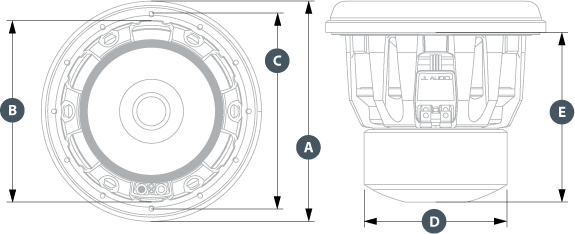
- Nominal Diameter 10.0 in / 250 mm
- Overall Diameter (A) 10.5 in / 267 mm
- Mounting Hole Diameter (B) 8.74 in / 222 mm
- Bolt Hole Circle Diameter (C) 9.34 in / 237 mm
- Motor Outer Diameter (D) 6.55 in / 166 mm
- Mounting Depth (E) 8.0 in / 203 mm
- Driver Displacement 0.09 cu ft / 2.5 L
- Net Weight 30 lb / 13.6 kg
- Free Air Resonance (Fs) 30.6 Hz
- Electrical “Q” (Qes) 0.578
- Mechanical “Q” (Qms) 7.647
- Total Speaker “Q” (Qts) 0.537
- Equivalent Compliance (Vas) 1.28 cu ft / 36.1 L
- One-Way Linear Excursion (Xmax)* 0.9 in / 23 mm
- Reference Efficiency (no) 0.17%
- Efficiency (1 W / 1 m)** 84.3 dB SPL
- Effective Piston Area (Sd) 59.8 sq in / 0.0386 sq m
- DC Resistance (Re) 2.75 Ω
Technology
 Dynamic Motor Analysis - DMA Optimized Motor
Summary:
JL Audio's proprietary Dynamic Motor Analysis system is a powerful suite of FEA-based modeling systems, first developed by JL Audio in 1997 and refined over the years to scientifically address the issue of speaker motor linearity. This leads to vastly reduced distortion and faithfully reproduced transients... or put simply: tight, clean, articulate bass.
Detailed Information:
Since 1997, JL Audio has been at the forefront of Finite Element Analysis-based modeling of loudspeaker motors and suspensions. This research is aimed at decoding what we refer to as the "Loudspeaker Genome"... a project aimed at understanding the true behavior of loudspeakers under power and in motion. A major component of this integrated system is DMA (Dynamic Motor Analysis). Starting with the 15W3 and the W7 Subwoofers in the late 1990's and early 2000's, DMA has played an important role in the design of all JL Audio woofers sold today, including our component woofers.
DMA is a Finite Element Analysis (FEA)-based system, meaning that it takes a large, complex problem, breaks it down into small solution elements for analysis and then assembles the data to form an accurate, "big-picture" solution. DMA's breakthrough is that it actually considers the effects of power through the coil as well as coil/cone position within the framework of a time-domain analysis. This gives us a highly accurate model of a speaker's actual behavior under real power, something that the traditional Thiele-Small models or other low power measurements cannot do. Because DMA does not rely on a steady-state model, it is able to consider shifts in the circuit elements being analyzed. These modeling routines are intense, requiring hours to run for a whole speaker.
DMA is able to analyze the real effects of fluctuating power and excursion upon the magnetic circuit of the motor, specifically the dynamic variations of the "fixed" magnetic field. This delivers intensely valuable information compared to traditional modeling, which assumes that the "fixed" field produced in the air gap by the magnet and the motor plates is unchanging. DMA not only shows that this "fixed" field changes in reaction to the magnetic field created by current flowing through the voice coil, but it helps our engineers arrive at motor solutions that minimize this instability. Analyzing this behavior is critical to understanding the distortion mechanisms of a speaker motor and sheds light on the aspects of motor design that determine truly linear behavior:
- Linear motor force over the speaker's operational excursion range
- Consistent motor force with both positive and negative current through the coil
- Consistent motor force at varying applied power levels
Our ability to fully analyze these aspects of motor behavior allows our transducer engineers to make critical adjustments to motor designs that result in extremely linear, highly stable dynamic loudspeaker motor systems.
The payoff is reduced distortion, improved transient performance and stellar sound quality.

W-Cone (U.S. Patent #6,496,590)
Summary:
The W-Cone is a unit-body cone assembly that delivers astonishing cone stiffness with minimal mass. The shape also provides superb torsional rigidity, which is critical to maintaining voice coil alignment at the suspension limits.
Detailed Information:
The more excursion and motor force a speaker has, the more important cone rigidity becomes. The acceleration forces are extreme, requiring the cone to withstand rapid changes in speed and direction without deformation. Deformation not only leads to distortion, but can also affect the speaker's mechanical integrity by allowing the voice coil to go out of alignment and rub on the top-plate and the pole-piece of the motor.
There are several approaches to enhancing cone rigidity. The obvious ones are using a thicker material and/or a stiffer material. In recent years, several manufacturers have used composite cone materials (Kevlar®, fiberglass, etc.) or metals (aluminum, magnesium, titanium alloys). The use of these exotic materials is typically accompanied by marketing claims that the material chosen has exceptional stiffness-to-mass characteristics. These are true statements, but can be misleading. While these materials have excellent stiffness-to-mass properties (compared to paper or poly), they are not lighter than paper or poly in practice. This means that their use accepts the compromise of added moving mass on the design. This leads to efficiency penalties and suspension complications (it's harder to keep a heavy mass aligned properly).
A simple poly cone diaphragm, while sufficient for lower power designs, would not remain rigid under the demands that the W7 design requires. Our engineering team knew that high levels of cone rigidity would be needed, but they focused on achieving rigidity without a huge weight penalty. This ultimately led to the design we call the W-Cone. The W-Cone assembly achieves its rigidity through architectural means, rather than through inherently stiff materials. The design addresses the stiffness issue by using two lightweight mineral-filled polypropylene skins, bonded together at the perimeter and the center of the assembly. The lower skin's cross-section is shaped like a 'W', hence the name, and provides incredible rigidity when bonded to the dished upper skin. The effect is not unlike the trusses of a bridge or the unit-body construction of a modern automobile. In addition to the overall rigidity benefit, the lower skin's shape distributes the force generated by the coil and motor more evenly than a typical diaphragm. The force is not only applied to the apex but also distributed to the perimeter of the outer diaphragm for more linear behavior. A further benefit of the W-Cone is that the upper skin (the one in contact with the listening environment), is isolated from the high air-pressure gradients of the enclosure, further reducing deformation (and distortion).
As a point of comparison, the W-Cone assembly of a 12W7 is 32% lighter than a typical aluminum-alloy 12-inch cone. If analyzed in terms of weight per square inch of piston area, the W7 cone-body weighs 1.24g/sq.in., compared to 1.45g/sq.in. for an aluminum-alloy cone and 1.66g/sq.in. for a titanium-alloy cone.
So why polypropylene" As stated above, our patented W-Cone technology achieves all of the benefits of more exotic materials while
better suiting the unique nature of the W7. Since the W7 surround is detachable, the moving system (including the diaphragm) is
subject to mechanical stress unseen in conventional designs. Because the user can tug on the cone while manipulating the surround, the
cone must be able to handle this without buckling or deforming. Paper, metal or brittle composite cones would not handle this well.
Our two-skin unit-body cone design achieves outstanding axial and torsional stiffness to withstand all kinds of abuse, and will remain
largely unaffected and unblemished.
 Elevated Frame Cooling (U.S. Patent #6,219,431 & #6,229,902)
Summary:
JL Audio's patented Elevated Frame Cooling design delivers cool air through slots directly above the top-plate to the voice coil of the speaker. This not only enhances power handling, but also sound quality by minimizing dynamic parameter shifts and power compression.
Detailed Information:
Many speakers employ venting techniques to enhance voice coil cooling. This is typically accomplished by having big holes in the sides of the frame just below the spider attachment shelf. While it provides a modest cooling benefit, this low-velocity air-flow does not blow directly or strongly on the voice coil.
Our patented design improves upon this cooling technique in a number of ways. By elevating the frame above the top-plate of the motor (via stand-offs integrated into the bottom of the frame) a narrow, high-velocity air-path is created between the bottom surface of the frame and the top surface of the top-plate. This air path leads directly to the voice coil and then turns upward into the spider air cavity. By utilizing the pumping action of the spider through this focused air path, a large volume of cool air hits the coil windings directly.
Another important benefit is that the upper surface of the top-plate (one of the speaker's hottest parts) is directly exposed to
cooling air flow, whereas on a conventional design it is isolated from the air flow by the lower flange of the frame. The elevated
frame technology greatly increases thermal power handling, reduces compression effects and does so without any additional parts.

Floating Cone Attach Method - FCAM™ (U.S. Patent #6,501,844)
Summary:
This assembly technique, conceived by JL Audio, ensures proper surround geometry in the assembled speaker for better excursion control
and dynamic voice coil alignment.
Detailed Information:
JL Audio's patented FCAM™ technology is an innovative method of bonding the surround/cone assembly to the voice coil former/spider assembly. This feature helps ensure concentricity of the surround, spider and voice coil without torquing the suspension to achieve it. This allows for the inevitable, slight variations in production part dimensions without having them negatively impact the integrity of the suspension and coil-centering at high excursions.
 OverRoll Surround
Summary:
By utilizing space wasted in conventional speakers, this ground-breaking innovation controls the W7's massive excursion without sacrificing precious cone area.
Detailed Information:
One of the first things you notice about a W7 is that something is "missing"... the mounting flange. Of course, this is actually not the case. The mounting flange is simply hidden beneath the surround and is made accessible for mounting purposes by detaching the outer edge of the surround and moving the roll to the inside (a pretty neat little trick). Apart from the obvious benefits of amazing your friends as you pull the surround off your speaker, there is a serious technical issue that led us in this design direction: Effective Piston Area ("Sd"). This is essentially the speaker's "cylinder bore", to use an automotive engine analogy, and is calculated by measuring the diameter of the diaphragm including one-half of the surround roll-width. In other words, from the top- center of the surround on one side to top-center of the surround on the other side.
The displacement capability of a speaker is determined by this piston area times the speaker's excursion capability. Displacement of air is directly linked to output potential. Therefore, the more air a speaker can ultimately displace, the louder it can play. That being said, there is a big difference between piston area and excursion: piston area doesn't need power to make it happen. This means that by making a larger piston, you are directly improving displacement for a given amount of excursion and, therefore, making your speaker more efficient. This is not the only factor that governs efficiency, but it is a major one.
To make a speaker have more excursion capability not only requires a motor design that can deliver more stroke, but also requires a surround rugged enough to handle the demands of longer excursions and controlled enough to keep everything lined up properly. If the surround's roll-width is not adequately large, its behavior (compliance) is not linear over the useful stroke of the woofer and it is more likely to fatigue and fail. For this reason, speakers with longer excursion capability generally need larger surround rolls (we won't comment on the ones that use large rolls strictly for cosmetic effect).
The problem with big surrounds is that they begin to encroach on the effective piston area of the driver. For example, a typical 12- inch woofer with a medium-sized roll has an effective piston area of 81.52 square inches. Compare this to a fat-surround 12-inch woofer which has a piston area of 69.07 square inches (15.2 % less effective piston area than the medium-size roll.) To overcome this loss, the fat-surround woofer has to produce more excursion to displace the same air as the woofer with the medium surround (and will require more power to do so).
OverRoll™ technology neatly sidesteps this compromise by allowing us to make full use of the entire footprint of the speaker, placing the surround further to the outside than in a conventional woofer. This means that we can use a large roll for all its benefits without sacrificing cone area (in fact, the 12W7 has 1% more piston area than the medium-surround conventional woofer). By maximizing the effective piston/total footprint ratio, we can deliver more output for a given excursion and outside frame diameter. This means that the prodigious excursion advantage of the W7 can be put to full use enhancing output, rather than making up for lost piston area.
The technology also provides a geometry advantage on the outside edge of the surround roll, allowing for more linear operation. A further benefit is that the mounting holes are inherently sealed by the surround, resulting in an improved box seal.
 Radially Cross-Drilled Pole-Piece (U.S. Patent #6,243,479)
Summary:
This innovative venting system greatly enhances thermal dissipation and power handling by directing air flow onto the voice coil former, working in conjunction with the Elevated Frame cooling technology to effectively remove heat from the voice coil. This improves power handling and reduces power compression effects, leading to more linear performance.
Detailed Information:
This technology differs from a conventionally vented pole-piece in that the air flow is capped off at the top of the pole-piece and directed through machined holes on the outer wall of the pole-piece to the region directly behind the voice coil. The top portion of the pole-piece is smaller in outside diameter where the holes vent and helps create a high-volume, high-velocity airflow path between the inner-coil cavity and the ambient air of the enclosure.This helps remove super-heated air that is trapped between the coil former and pole-piece on a conventional design, leading to a dramatic improvement in cooling efficiency, especially at high excursions.
 Engineered Lead-Wire System (U.S. Patent #7,356,157)
Summary:
Carefully engineered lead-wire design and attachments ensure controlled, quiet lead-wire behavior under the most extreme excursion demands.
Detailed Information:
Managing the lead-wires on a long-excursion woofer is one of the trickier aspects of its mechanical design. To address this, many long-excursion woofers today rely on a simple solution that weaves the lead-wires into the spider (rear suspension) of the driver.
The biggest problem with this approach is that spider limiting behavior plays a hugely important role a woofer's performance. Lead- wires that are attached or woven into the spider material can alter the spider's "stretching" behavior. The tinsel wire naturally has less 'give' than the fabric material of the spider leading to asymmetrical spider behavior and non-uniform stress distribution around the spider circumference. The wire attachment points can also cause localized pulling and tearing forces at the spider's excursion limits. As such, longevity becomes a major concern and makes the woven-in design less than ideal for very long-excursion designs.
While a traditional 'flying lead' design does not compromise spider linearity or radial stability, it creates its own challenges on a long-excursion woofer. Managing the 'whipping' behavior of the wire and making sure it does not contact the cone or spider is one challenge. Another is ensuring that the leads do not short one another or the frame of the woofer.
To overcome these issues, JL Audio's engineered flying lead-wires work in conjunction with carefully engineered entry and exit support structures molded into the terminals and the voice coil collar. Some models also feature jacketed lead-wires to further reduce the likelihood of shorting and fatigue. The result is flawless high-excursion lead-wire behavior, with outstanding reliability and none of the compromises inherent to a woven-in lead wire system. Building woofers this way requires much more labor and parts complexity than the simpler woven-in approach, but the payoff is in reduced distortion, reduced mechanical noise and improved reliability.
 Built in U.S.A. with Global Components
Summary:
JL Audio's Miramar, Florida loudspeaker production facility is one of the most advanced in the world.
Detailed Information:
At a time when most audio products are built overseas, JL Audio’s commitment to in-house loudspeaker production continues to grow. To pull this off in a competitive world market, our production engineering team has created one of the world’s most advanced loudspeaker assembly facilities and established a global network of quality component suppliers who build to our specifications. This, combined with our commitment to state-of-the-art assembly technology, allows our skilled workforce to efficiently build JL Audio products to extremely high quality standards, right here in the U.S.A.
Since most of our premium loudspeakers incorporate proprietary, patented technologies requiring specific assembly techniques, we find it is vital that the people who designed them have close access to the people manufacturing them. The following JL Audio products are built in our Miramar, Florida factory, with global components:
- Subwoofer Drivers: W7, W6v3, TW5v2, TW3, TW1, W3v3
- Enclosed Car Subwoofers: Stealthbox®, PowerWedge™, ProWedge™, H.O. Wedge™ & MicroSub™ Enclosed Subwoofers
- Marine Loudspeakers, Marine Subwoofer Drivers and Marine Enclosed Loudspeakers
- Home Subwoofers: Dominion™, E-Sub, Fathom® and Gotham®
Available for Shipping Only
Hide Details
Show Details
Hide Details
Show Details
JL Audio 10W7AE-3 10" Subwoofer Driver 3 Ohm Sku 92114 OverviewIf you are seeking reference-grade...

JL Audio 10TW3-D8 Thin-Line 10" Subwoofer
- 400 Watts RMS
- Dual 8-Ohm Voice Coils
- Mica-Filled Polypropylene Cone
Available for Shipping Only
Hide Details
Show Details
Hide Details
Show Details
JL Audio 10TW3-D8 Thin-Line 10" Subwoofer Building on the core technology of our TW5 thin-line...

Kicker 42CWQ104 CompQ10 Q-Class 10" Subwoofer - 4 Ohm
Kicker 42CWQ104 CompQ10 Q-Class 10" Subwoofer - 4 Ohm
The CompQ delivers everything on the wish list for high-caliber bass. Huge voice coils provide tremendous power handling and prodigious magnets help to create incredibly high SPL. The CompQ 10-Inch Subwoofer works best with a sealed or ported enclosure with 700 watts of recommended power. See below for more details. Thanks to outstanding power handling next-level structural stability and a unique power plant the CompQ discovers every note with miraculous detail. All with the highest RMS power rating Kicker ever achieved in a round subwoofer. Stabilize KICKERs unique cone bracing technology ensures perfectly linear cone movement while the Blue Lace adds even more stability to the sub. Take the Power A ceramic magnet and computer-optimized voice coil provide outstanding power handling while the UniPlate pole piece backplate ensure the CompQ stays cool even under extreme power loads. Join Forces Spring-loaded copper terminals hold as much as an 8-gauge speaker wire while extra thick tinsel leads bring all that music directly to the voice coil. You get every watt of power right where you want it. The 10" CompQ 4 Ohm The CompQ 10 Subwoofer is the best sound quality round driver Kicker's ever made with nearly identical construction and performance as their L7 square subs. Specifications
Thiele/Small Parameters: 42CWQ104 T/S Parameters
Product Dimension Sheet: 42CWQ10 Dimensions
Rated Impedance [Ω]: 4
Sensitivity [1W, 1m]: 85.7
Frequency Response [Hz]: 24 – 100
Recommended Amplifier Power (watts RMS): 700
Outer Frame Dimension [in, cm]: 10-11/16, 27.2
Mounting Depth [in, cm]: 6-3/8, 16.2
Mounting Cutout [in, cm]: 9-3/16, 23.4
Sealed Enclosure Specs Minimum Sealed Volume ft3 (L): .66 (18.7)
Maximum Sealed Volume ft3 (L): 1.25 (35.4) Panel Dimensions for Minimum Sealed Enclosures using 3/4” (1.9cm) thick MDF
Box Volume [ft³, L]: .66 (18.7)
Panel A [in, cm]: 12x12, 30.5x30.5
Panel B [in, cm]: 12x10.5, 30.5x26.7
Panel C [in, cm]: 10.5x10.5, 26.7x26.7 Vented Minimum
Box Volume, ft³ (L) + port displacement: 1.25, 35.4
Port Opening Size, in x in (cm x cm): 2.5x11.25, 6.4x29
Port Length, in (cm): 19.75, 50 Vented Maximum
Box Volume, ft³ (L): 2.25, 63.7
Port Opening, in x in (cm x cm): 3x11.25, 7.6x29
Port Length, in (cm): 18, 46
Out of stock
Hide Details
Show Details
Hide Details
Show Details
Kicker 42CWQ104 CompQ10 Q-Class 10" Subwoofer - 4 Ohm The CompQ delivers everything on the...

Kenwood eXcelon XR1001-1 Subwoofer Amplifier
- 500 Watts RMS x 1 at 4 Ohms
- 1000 Watts RMS x 1 at 2 Ohms
- Speaker Level Input
Available for Shipping Only
Hide Details
Show Details
Hide Details
Show Details
Kenwood eXcelon XR1001-1 Subwoofer Amplifier Kenwood's Excelon Reference Series XR1001-1 mono amplifier can power your...