Showing 50 of 94 items
50 Items
Sort by:
A - Z

JL Audio 10TW3-D4 10 Inch Subwoofer Driver
- Very shallow mounting depth (3.25 / 3.50 Inches)
- No pole vent: permits mounting close to rear wall of enclosure.
- Very small sealed enclosure volume requirements
Hide Details
Show Details
Hide Details
Show Details
10TW3-D4 TW3 10-inch Subwoofer Driver (400 W, dual 4 Ω voice coils) Building on the...

JL Audio 10TW3-D8 Thin-Line 10" Subwoofer
- 400 Watts RMS
- Dual 8-Ohm Voice Coils
- Mica-Filled Polypropylene Cone
Available for Shipping Only
Hide Details
Show Details
Hide Details
Show Details
JL Audio 10TW3-D8 Thin-Line 10" Subwoofer Building on the core technology of our TW5 thin-line...

JL Audio 10W1V3-2 10 Inch Subwoofer
JL Audio 10W1v3-2
W1v3 10-inch Subwoofer Driver (300 W, 2 Ω)
 The 10W1v3 is an outstanding choice when space is very tight and amplifier power is moderate. It features shallow mounting depth (4.6 in. / 117 mm) and a compact motor structure, allowing it to comfortably fit in a lot of spaces where a typical 10-inch driver will not. Lacking a pole vent, the rear of the motor structure can be placed directly against an enclosure boundary. Excellent excursion capability and linearity allow it to reproduce sub-bass with shocking extension and quality. Several of JL Audio's proprietary technologies enhance its performance and reliability.
The 10W1v3-2 is best used with amplifier power in the 75W - 300W range and is optimized to operate in a compact 0.55 cu. ft. (15.57 l) sealed enclosure.
General Specifications
The 10W1v3 is an outstanding choice when space is very tight and amplifier power is moderate. It features shallow mounting depth (4.6 in. / 117 mm) and a compact motor structure, allowing it to comfortably fit in a lot of spaces where a typical 10-inch driver will not. Lacking a pole vent, the rear of the motor structure can be placed directly against an enclosure boundary. Excellent excursion capability and linearity allow it to reproduce sub-bass with shocking extension and quality. Several of JL Audio's proprietary technologies enhance its performance and reliability.
The 10W1v3-2 is best used with amplifier power in the 75W - 300W range and is optimized to operate in a compact 0.55 cu. ft. (15.57 l) sealed enclosure.
General Specifications
![Table_Image]()
![DMA Optimized]()
JL Audio's proprietary Dynamic Motor Analysis system is a powerful suite of FEA-based modeling systems, first developed by JL Audio in 1997 and refined over the years to scientifically address the issue of speaker motor linearity. This leads to vastly reduced distortion and faithfully reproduced transients... or put simply: tight, clean, articulate bass. Detailed Information:
Since 1997, JL Audio has been at the forefront of Finite Element Analysis-based modeling of loudspeaker motors and suspensions. This research is aimed at decoding what we refer to as the "Loudspeaker Genome"... a project aimed at understanding the true behavior of loudspeakers under power and in motion. A major component of this integrated system is DMA (Dynamic Motor Analysis). Starting with the 15W3v3 and the W7 Subwoofers in the late 1990's and early 2000's, DMA has played an important role in the design of all JL Audio woofers sold today, including our component woofers. DMA is a Finite Element Analysis (FEA)-based system, meaning that it takes a large, complex problem, breaks it down into small solution elements for analysis and then assembles the data to form an accurate, "big-picture" solution. DMA's breakthrough is that it actually considers the effects of power through the coil as well as coil/cone position within the framework of a time-domain analysis. This gives us a highly accurate model of a speaker's actual behavior under real power, something that the traditional Thiele-Small models or other low power measurements cannot do. Because DMA does not rely on a steady-state model, it is able to consider shifts in the circuit elements being analyzed. These modeling routines are intense, requiring hours to run for a whole speaker. DMA is able to analyze the real effects of fluctuating power and excursion upon the magnetic circuit of the motor, specifically the dynamic variations of the "fixed" magnetic field. This delivers intensely valuable information compared to traditional modeling, which assumes that the "fixed" field produced in the air gap by the magnet and the motor plates is unchanging. DMA not only shows that this "fixed" field changes in reaction to the magnetic field created by current flowing through the voice coil, but it helps our engineers arrive at motor solutions that minimize this instability. Analyzing this behavior is critical to understanding the distortion mechanisms of a speaker motor and sheds light on the aspects of motor design that determine truly linear behavior:
![Elevated Frame Cooling]()
JL Audio's patented Elevated Frame Cooling design delivers cool air through slots directly above the top-plate to the voice coil of the speaker. This not only enhances power handling, but also sound quality by minimizing dynamic parameter shifts and power compression. Detailed Information:
Many speakers employ venting techniques to enhance voice coil cooling. This is typically accomplished by having big holes in the sides of the frame just below the spider attachment shelf. While it provides a modest cooling benefit, this low-velocity air-flow does not blow directly or strongly on the voice coil. Our patented design improves upon this cooling technique in a number of ways. By elevating the frame above the top-plate of the motor (via stand-offs integrated into the bottom of the frame) a narrow, high-velocity air-path is created between the bottom surface of the frame and the top surface of the top-plate. This air path leads directly to the voice coil and then turns upward into the spider air cavity. By utilizing the pumping action of the spider through this focused air path, a large volume of cool air hits the coil windings directly. Another important benefit is that the upper surface of the top-plate (one of the speaker's hottest parts) is directly exposed to cooling air flow, whereas on a conventional design it is isolated from the air flow by the lower flange of the frame. The elevated frame technology greatly increases thermal power handling, reduces compression effects and does so without any additional parts.
![FCAM]()
This assembly technique, conceived by JL Audio, ensures proper surround geometry in the assembled speaker for better excursion control and dynamic voice coil alignment. Detailed Information:
JL Audio's patented FCAM™ technology is an innovative method of bonding the surround/cone assembly to the voice coil former/spider assembly. This feature helps ensure concentricity of the surround, spider and voice coil without torquing the suspension to achieve it. This allows for the inevitable, slight variations in production part dimensions without having them negatively impact the integrity of the suspension and coil-centering at high excursions.
![Vented Reinforcement Collar]()
JL Audio's patented Vented Reinforcement Collar (VRC®) improves the rigidity and stability of the cone/spider/voice coil junction and directs airflow over the voice coil windings for improved thermal performance. Detailed Information:
The Vented Reinforcement Collar (VRC®) is a composite structure that addresses two issues related to reliability. By reinforcing the critical junction betweeen the cone, voice coil and spider, the VRC greatly reduces failures due to glue breakdown or material weakness. It does this by greatly increasing adhesive contact area and providing stress relief to the spider material at excursion extremes. The VRC™ also features slots that facilitate air flow directly onto the voice coil windings. This reduces thermal compression effects and enhances reliability.
Current versions of the VRC™ also incorporate lead-wire strain relief structures to improve mechanical reliability.
The VRC™ also features slots that facilitate air flow directly onto the voice coil windings. This reduces thermal compression effects and enhances reliability.
Current versions of the VRC™ also incorporate lead-wire strain relief structures to improve mechanical reliability.
![Insert Molded Suspension / Coil / Terminal Sub-Assembly]()
Spiders, voice coils, terminals and lead wires are preassembled, using a patent-pending process, onto a composite carrier for improved precision and reliability. Detailed Information:
A conventional speaker is assembled in layers. In other words, multiple parts are assembled and glued sequentially into the basket, leading to stacking of tolerances and making it difficult to achieve optimal assembly precision. JL Audio's patent-pending insert-molded spider carrier permanently bonds the spider to a mechanically robust carrier that also incorporates the terminal assembly and lead wire strain relief features for enhanced relability and optimal alignment of parts. This subassembly is assembled outside the speaker basket, for optimum alignment and glue-joint integrity. The benefit is a more precisely built, more mechanically sound loudspeaker.
![Customizable Trim Ring]()
This removable ring can be painted to match the installation theme and directly receives JL Audio grille mesh inserts (sold separately). Detailed Information:
This ABS trim ring is molded in black, but that doesn't mean it has to stay that way. By custom painting it, you can match your installation theme and create a personalized look.
Specifically-designed grille mesh inserts are available separately and fit into the inner diameter of the trim ring. Helpful Tip: Installing the grille mesh inserts is much easier before mounting the woofer into the enclosure.
![Engineered Lead-Wire System]()
Carefully engineered lead-wire design and attachments ensure controlled, quiet lead-wire behavior under the most extreme excursion demands. Detailed Information:
Managing the lead-wires on a long-excursion woofer is one of the trickier aspects of its mechanical design. To address this, many long-excursion woofers today rely on a simple solution that weaves the lead-wires into the spider (rear suspension) of the driver. The biggest problem with this approach is that spider limiting behavior plays a hugely important role a woofer's performance. Lead-wires that are attached or woven into the spider material can alter the spider's "stretching" behavior. The tinsel wire naturally has less 'give' than the fabric material of the spider leading to asymmetrical spider behavior and non-uniform stress distribution around the spider circumference. The wire attachment points can also cause localized pulling and tearing forces at the spider's excursion limits. As such, longevity becomes a major concern and makes the woven-in design less than ideal for very long-excursion designs. While a traditional 'flying lead' design does not compromise spider linearity or radial stability, it creates its own challenges on a long-excursion woofer. Managing the 'whipping' behavior of the wire and making sure it does not contact the cone or spider is one challenge. Another is ensuring that the leads do not short one another or the frame of the woofer. To overcome these issues, JL Audio's engineered flying lead-wires work in conjunction with carefully engineered entry and exit support structures molded into the terminals and the voice coil collar. Some models also feature jacketed lead-wires to further reduce the likelihood of shorting and fatigue. The result is flawless high-excursion lead-wire behavior, with outstanding reliability and none of the compromises inherent to a woven-in lead wire system. Building woofers this way requires much more labor and parts complexity than the simpler woven-in approach, but the payoff is in reduced distortion, reduced mechanical noise and improved reliability.
| Continuous Power Handling (RMS) | 300 W |
| Recommended RMS Amplifier Power | 75 - 300 W |
| Nominal Impedance (Znom) | 2 Ω |
Physical Specifications
** Efficiency (1 W / 1 m) is not an accurate indicator of a subwoofer’s output capability and should not be used as a comparison to other subwoofers to determine which one is “louder”.
- Nominal Diameter 10.0 in / 250 mm
- Overall Diameter (A) 10.5 in / 267 mm
- Mounting Hole Diameter (B) 9.0625 in / 230 mm
- Bolt Hole Circle (C) 9.7 in / 246 mm
- Magnet Diameter (D) 4.92 in / 125 mm
- Mounting Depth (E) 4.6 in / 117 mm
- Driver Displacement 0.037 cu ft / 1.05 L
- Net Weight 9.9 lb / 4.5 kg
- Free Air Resonance (Fs) 25.23 Hz
- Electrical “Q” (Qes) 0.463
- Mechanical “Q” (Qms) 7.246
- Total Speaker “Q” (Qts) 0.436
- Equivalent Compliance (Vas) 1.559 cu ft / 44.15 L
- One-Way Linear Excursion (Xmax)* 0.45 in / 11 mm
- Reference Efficiency (no) 0.1500%
- Efficiency (1 W / 1 m)** 83.9 dB SPL
- Effective Piston Area (Sd) 53.584 sq in / 0.0346 sq m
- DC Resistance (Re) 2.233 Ω
** Efficiency (1 W / 1 m) is not an accurate indicator of a subwoofer’s output capability and should not be used as a comparison to other subwoofers to determine which one is “louder”.
Dynamic Motor Analysis - DMA Optimized Motor
Summary:JL Audio's proprietary Dynamic Motor Analysis system is a powerful suite of FEA-based modeling systems, first developed by JL Audio in 1997 and refined over the years to scientifically address the issue of speaker motor linearity. This leads to vastly reduced distortion and faithfully reproduced transients... or put simply: tight, clean, articulate bass. Detailed Information:
Since 1997, JL Audio has been at the forefront of Finite Element Analysis-based modeling of loudspeaker motors and suspensions. This research is aimed at decoding what we refer to as the "Loudspeaker Genome"... a project aimed at understanding the true behavior of loudspeakers under power and in motion. A major component of this integrated system is DMA (Dynamic Motor Analysis). Starting with the 15W3v3 and the W7 Subwoofers in the late 1990's and early 2000's, DMA has played an important role in the design of all JL Audio woofers sold today, including our component woofers. DMA is a Finite Element Analysis (FEA)-based system, meaning that it takes a large, complex problem, breaks it down into small solution elements for analysis and then assembles the data to form an accurate, "big-picture" solution. DMA's breakthrough is that it actually considers the effects of power through the coil as well as coil/cone position within the framework of a time-domain analysis. This gives us a highly accurate model of a speaker's actual behavior under real power, something that the traditional Thiele-Small models or other low power measurements cannot do. Because DMA does not rely on a steady-state model, it is able to consider shifts in the circuit elements being analyzed. These modeling routines are intense, requiring hours to run for a whole speaker. DMA is able to analyze the real effects of fluctuating power and excursion upon the magnetic circuit of the motor, specifically the dynamic variations of the "fixed" magnetic field. This delivers intensely valuable information compared to traditional modeling, which assumes that the "fixed" field produced in the air gap by the magnet and the motor plates is unchanging. DMA not only shows that this "fixed" field changes in reaction to the magnetic field created by current flowing through the voice coil, but it helps our engineers arrive at motor solutions that minimize this instability. Analyzing this behavior is critical to understanding the distortion mechanisms of a speaker motor and sheds light on the aspects of motor design that determine truly linear behavior:
- Linear motor force over the speaker's operational excursion range
- Consistent motor force with both positive and negative current through the coil
- Consistent motor force at varying applied power levels
Elevated Frame Cooling (U.S. Patent #6,219,431 & #6,229,902)
Summary:JL Audio's patented Elevated Frame Cooling design delivers cool air through slots directly above the top-plate to the voice coil of the speaker. This not only enhances power handling, but also sound quality by minimizing dynamic parameter shifts and power compression. Detailed Information:
Many speakers employ venting techniques to enhance voice coil cooling. This is typically accomplished by having big holes in the sides of the frame just below the spider attachment shelf. While it provides a modest cooling benefit, this low-velocity air-flow does not blow directly or strongly on the voice coil. Our patented design improves upon this cooling technique in a number of ways. By elevating the frame above the top-plate of the motor (via stand-offs integrated into the bottom of the frame) a narrow, high-velocity air-path is created between the bottom surface of the frame and the top surface of the top-plate. This air path leads directly to the voice coil and then turns upward into the spider air cavity. By utilizing the pumping action of the spider through this focused air path, a large volume of cool air hits the coil windings directly. Another important benefit is that the upper surface of the top-plate (one of the speaker's hottest parts) is directly exposed to cooling air flow, whereas on a conventional design it is isolated from the air flow by the lower flange of the frame. The elevated frame technology greatly increases thermal power handling, reduces compression effects and does so without any additional parts.
Floating Cone Attach Method - FCAM™ (U.S. Patent #6,501,844)
Summary:This assembly technique, conceived by JL Audio, ensures proper surround geometry in the assembled speaker for better excursion control and dynamic voice coil alignment. Detailed Information:
JL Audio's patented FCAM™ technology is an innovative method of bonding the surround/cone assembly to the voice coil former/spider assembly. This feature helps ensure concentricity of the surround, spider and voice coil without torquing the suspension to achieve it. This allows for the inevitable, slight variations in production part dimensions without having them negatively impact the integrity of the suspension and coil-centering at high excursions.
Vented Reinforcement Collar (U.S. Patent #5,734,734)
Summary:JL Audio's patented Vented Reinforcement Collar (VRC®) improves the rigidity and stability of the cone/spider/voice coil junction and directs airflow over the voice coil windings for improved thermal performance. Detailed Information:
The Vented Reinforcement Collar (VRC®) is a composite structure that addresses two issues related to reliability. By reinforcing the critical junction betweeen the cone, voice coil and spider, the VRC greatly reduces failures due to glue breakdown or material weakness. It does this by greatly increasing adhesive contact area and providing stress relief to the spider material at excursion extremes.
The VRC™ also features slots that facilitate air flow directly onto the voice coil windings. This reduces thermal compression effects and enhances reliability.
Current versions of the VRC™ also incorporate lead-wire strain relief structures to improve mechanical reliability.
Insert Molded Suspension / Coil / Terminal Sub-Assembly (U.S. Patent #7,379,558)
Summary:Spiders, voice coils, terminals and lead wires are preassembled, using a patent-pending process, onto a composite carrier for improved precision and reliability. Detailed Information:
A conventional speaker is assembled in layers. In other words, multiple parts are assembled and glued sequentially into the basket, leading to stacking of tolerances and making it difficult to achieve optimal assembly precision. JL Audio's patent-pending insert-molded spider carrier permanently bonds the spider to a mechanically robust carrier that also incorporates the terminal assembly and lead wire strain relief features for enhanced relability and optimal alignment of parts. This subassembly is assembled outside the speaker basket, for optimum alignment and glue-joint integrity. The benefit is a more precisely built, more mechanically sound loudspeaker.
Customizable Trim Ring (U.S. Patent #D480,709)
Summary:This removable ring can be painted to match the installation theme and directly receives JL Audio grille mesh inserts (sold separately). Detailed Information:
This ABS trim ring is molded in black, but that doesn't mean it has to stay that way. By custom painting it, you can match your installation theme and create a personalized look.
Specifically-designed grille mesh inserts are available separately and fit into the inner diameter of the trim ring. Helpful Tip: Installing the grille mesh inserts is much easier before mounting the woofer into the enclosure.
Engineered Lead-Wire System (U.S. Patent #7,356,157)
Summary:Carefully engineered lead-wire design and attachments ensure controlled, quiet lead-wire behavior under the most extreme excursion demands. Detailed Information:
Managing the lead-wires on a long-excursion woofer is one of the trickier aspects of its mechanical design. To address this, many long-excursion woofers today rely on a simple solution that weaves the lead-wires into the spider (rear suspension) of the driver. The biggest problem with this approach is that spider limiting behavior plays a hugely important role a woofer's performance. Lead-wires that are attached or woven into the spider material can alter the spider's "stretching" behavior. The tinsel wire naturally has less 'give' than the fabric material of the spider leading to asymmetrical spider behavior and non-uniform stress distribution around the spider circumference. The wire attachment points can also cause localized pulling and tearing forces at the spider's excursion limits. As such, longevity becomes a major concern and makes the woven-in design less than ideal for very long-excursion designs. While a traditional 'flying lead' design does not compromise spider linearity or radial stability, it creates its own challenges on a long-excursion woofer. Managing the 'whipping' behavior of the wire and making sure it does not contact the cone or spider is one challenge. Another is ensuring that the leads do not short one another or the frame of the woofer. To overcome these issues, JL Audio's engineered flying lead-wires work in conjunction with carefully engineered entry and exit support structures molded into the terminals and the voice coil collar. Some models also feature jacketed lead-wires to further reduce the likelihood of shorting and fatigue. The result is flawless high-excursion lead-wire behavior, with outstanding reliability and none of the compromises inherent to a woven-in lead wire system. Building woofers this way requires much more labor and parts complexity than the simpler woven-in approach, but the payoff is in reduced distortion, reduced mechanical noise and improved reliability.
Out of stock
Hide Details
Show Details
Hide Details
Show Details
JL Audio 10W1v3-2 W1v3 10-inch Subwoofer Driver (300 W, 2 Ω) The 10W1v3 is an...

JL Audio 10W3v3-2 10 Inch Subwoofer Driver 2 ohm
JL Audio 10W3v3-2
10" Subwoofer Driver 2 ohm sku 92150Overview
This acclaimed subwoofer driver strikes an outstanding balance in power handling, enclosure requirements and excursion to deliver excellent results in medium power applications. Several exclusive JL Audio technologies and proprietary assembly techniques are applied to the 10W3v3 to enhance linearity and reliability.
The 10W3v3-2 is best used with amplifier power in the 150W - 500W range and is optimized to operate in a compact 0.625 cu. ft. (17.7 l) sealed enclosure, or a 1.25 cu. ft. (35.4 l) ported enclosure.
Specifications
General Specifications- Continuous Power Handling (RMS) 500 W
- Recommended Amplifier Power (RMS) 150- 500 W
- Nominal Impedance (Znom) 2 Ω
Physical Specifications
- Nominal Diameter 10.0 in / 250 mm
- Overall Diameter 10.5 in / 267 mm
- Mounting Hole Diameter 9.0625 in / 230 mm
- Bolt Hole Circle Diameter 9.7 in / 246.5 mm
- Motor Outer Diameter 5.25 in / 133 mm
- Mounting Depth 5.93 in / 151 mm
- Driver Displacement 0.049 cu ft / 1.39 L
- Net Weight 12.25 lb / 5.56 kg
Parameters
- Free Air Resonance (Fs) 32.97 Hz
- Electrical “Q” (Qes) 0.533
- Mechanical “Q” (Qms) 7.027
- Total Speaker “Q” (Qts) 0.495
- Equivalent Compliance (Vas) 1.136 cu ft / 32.17 L
- One-Way Linear Excursion (Xmax)* 0.550 in / 14.0 mm
- Reference Efficiency (no) 0.21%
- Efficiency (1 W / 1 m)** 85.37 dB SPL
- Effective Piston Area (Sd) 53.475 sq in / 0.0345 sq m
- DC Resistance (Re) 1.70 Ω
Dynamic Motor Analysis - DMA Optimized Motor
Summary:JL Audio's proprietary Dynamic Motor Analysis system is a powerful suite of FEA-based modeling systems, first developed by JL Audio in 1997 and refined over the years to scientifically address the issue of speaker motor linearity. This leads to vastly reduced distortion and faithfully reproduced transients... or put simply: tight, clean, articulate bass.
Detailed Information:
Since 1997, JL Audio has been at the forefront of Finite Element Analysis-based modeling of loudspeaker motors and suspensions. This research is aimed at decoding what we refer to as the "Loudspeaker Genome"... a project aimed at understanding the true behavior of loudspeakers under power and in motion. A major component of this integrated system is DMA (Dynamic Motor Analysis). Starting with the 15W3v3 and the W7 Subwoofers in the late 1990's and early 2000's, DMA has played an important role in the design of all JL Audio woofers sold today, including our component woofers.
DMA is a Finite Element Analysis (FEA)-based system, meaning that it takes a large, complex problem, breaks it down into small solution elements for analysis and then assembles the data to form an accurate, "big-picture" solution. DMA's breakthrough is that it actually considers the effects of power through the coil as well as coil/cone position within the framework of a time-domain analysis. This gives us a highly accurate model of a speaker's actual behavior under real power, something that the traditional Thiele-Small models or other low power measurements cannot do. Because DMA does not rely on a steady-state model, it is able to consider shifts in the circuit elements being analyzed. These modeling routines are intense, requiring hours to run for a whole speaker.
DMA is able to analyze the real effects of fluctuating power and excursion upon the magnetic circuit of the motor, specifically the dynamic variations of the "fixed" magnetic field. This delivers intensely valuable information compared to traditional modeling, which assumes that the "fixed" field produced in the air gap by the magnet and the motor plates is unchanging. DMA not only shows that this "fixed" field changes in reaction to the magnetic field created by current flowing through the voice coil, but it helps our engineers arrive at motor solutions that minimize this instability. Analyzing this behavior is critical to understanding the distortion mechanisms of a speaker motor and sheds light on the aspects of motor design that determine truly linear behavior:
- Linear motor force over the speaker's operational excursion range
- Consistent motor force with both positive and negative current through the coil
- Consistent motor force at varying applied power levels
Our ability to fully analyze these aspects of motor behavior allows our transducer engineers to make critical adjustments to motor designs that result in extremely linear, highly stable dynamic loudspeaker motor systems.
The payoff is reduced distortion, improved transient performance and stellar sound quality.
Elevated Frame Cooling (U.S. Patent #6,219,431 & #6,229,902)
Summary:JL Audio's patented Elevated Frame Cooling design delivers cool air through slots directly above the top-plate to the voice coil of the speaker. This not only enhances power handling, but also sound quality by minimizing dynamic parameter shifts and power compression.
Detailed Information:
Many speakers employ venting techniques to enhance voice coil cooling. This is typically accomplished by having big holes in the sides of the frame just below the spider attachment shelf. While it provides a modest cooling benefit, this low-velocity air-flow does not blow directly or strongly on the voice coil.
Our patented design improves upon this cooling technique in a number of ways. By elevating the frame above the top-plate of the motor (via stand-offs integrated into the bottom of the frame) a narrow, high-velocity air-path is created between the bottom surface of the frame and the top surface of the top-plate. This air path leads directly to the voice coil and then turns upward into the spider air cavity. By utilizing the pumping action of the spider through this focused air path, a large volume of cool air hits the coil windings directly.
Another important benefit is that the upper surface of the top-plate (one of the speaker's hottest parts) is directly exposed to cooling air flow, whereas on a conventional design it is isolated from the air flow by the lower flange of the frame. The elevated frame technology greatly increases thermal power handling, reduces compression effects and does so without any additional parts.
Floating Cone Attach Method - FCAM™ (U.S. Patent #6,501,844)
Summary:This assembly technique, conceived by JL Audio, ensures proper surround geometry in the assembled speaker for better excursion control and dynamic voice coil alignment.
Detailed Information:
JL Audio's patented FCAM™ technology is an innovative method of bonding the surround/cone assembly to the voice coil former/spider assembly. This feature helps ensure concentricity of the surround, spider and voice coil without torquing the suspension to achieve it. This allows for the inevitable, slight variations in production part dimensions without having them negatively impact the integrity of the suspension and coil-centering at high excursions.
Vented Reinforcement Collar (U.S. Patent #5,734,734)
Summary:JL Audio's patented Vented Reinforcement Collar (VRC®) improves the rigidity and stability of the cone/spider/voice coil junction and directs airflow over the voice coil windings for improved thermal performance.
Detailed Information:
The Vented Reinforcement Collar (VRC®) is a composite structure that addresses two issues related to reliability.
By reinforcing the critical junction betweeen the cone, voice coil and spider, the VRC greatly reduces failures due to glue breakdown or material weakness. It does this by greatly increasing adhesive contact area and providing stress relief to the spider material at excursion extremes.
The VRC™ also features slots that facilitate air flow directly onto the voice coil windings. This reduces thermal compression effects and enhances reliability.
Current versions of the VRC™ also incorporate lead-wire strain relief structures to improve mechanical reliability.
Insert Molded Suspension / Coil / Terminal Sub-Assembly (U.S. Patent #7,379,558)
Summary:Spiders, voice coils, terminals and lead wires are preassembled, using a patent-pending process, onto a composite carrier for improved precision and reliability.
Detailed Information:
A conventional speaker is assembled in layers. In other words, multiple parts are assembled and glued sequentially into the basket, leading to stacking of tolerances and making it difficult to achieve optimal assembly precision.
JL Audio's patent-pending insert-molded spider carrier permanently bonds the spider to a mechanically robust carrier that also incorporates the terminal assembly and lead wire strain relief features for enhanced relability and optimal alignment of parts. This subassembly is assembled outside the speaker basket, for optimum alignment and glue-joint integrity. The benefit is a more precisely built, more mechanically sound loudspeaker.
Customizable Trim Ring (U.S. Patent #D480,709)
Summary:This removable ring can be painted to match the installation theme and directly receives JL Audio grille mesh inserts (sold separately).
Detailed Information:
This ABS trim ring is molded in black, but that doesn't mean it has to stay that way. By custom painting it, you can match your installation theme and create a personalized look.
Specifically-designed grille mesh inserts are available separately and fit into the inner diameter of the trim ring.
Helpful Tip: Installing the grille mesh inserts is much easier before mounting the woofer into the enclosure.
Engineered Lead-Wire System (U.S. Patent #7,356,157)
Summary:Carefully engineered lead-wire design and attachments ensure controlled, quiet lead-wire behavior under the most extreme excursion demands.
Detailed Information:
Managing the lead-wires on a long-excursion woofer is one of the trickier aspects of its mechanical design. To address this, many long-excursion woofers today rely on a simple solution that weaves the lead-wires into the spider (rear suspension) of the driver.
The biggest problem with this approach is that spider limiting behavior plays a hugely important role a woofer's performance. Lead-wires that are attached or woven into the spider material can alter the spider's "stretching" behavior. The tinsel wire naturally has less 'give' than the fabric material of the spider leading to asymmetrical spider behavior and non-uniform stress distribution around the spider circumference. The wire attachment points can also cause localized pulling and tearing forces at the spider's excursion limits. As such, longevity becomes a major concern and makes the woven-in design less than ideal for very long-excursion designs.
While a traditional 'flying lead' design does not compromise spider linearity or radial stability, it creates its own challenges on a long-excursion woofer. Managing the 'whipping' behavior of the wire and making sure it does not contact the cone or spider is one challenge. Another is ensuring that the leads do not short one another or the frame of the woofer.
To overcome these issues, JL Audio's engineered flying lead-wires work in conjunction with carefully engineered entry and exit support structures molded into the terminals and the voice coil collar. Some models also feature jacketed lead-wires to further reduce the likelihood of shorting and fatigue. The result is flawless high-excursion lead-wire behavior, with outstanding reliability and none of the compromises inherent to a woven-in lead wire system. Building woofers this way requires much more labor and parts complexity than the simpler woven-in approach, but the payoff is in reduced distortion, reduced mechanical noise and improved reliability.
Precision Built in U.S.A.
Summary:JL Audio's Miramar, Florida loudspeaker production facility is one of the most advanced in the world.
Detailed Information:
At a time when most audio products are built overseas, JL Audio’s commitment to in-house loudspeaker production continues to grow. All W7’s, W6’s, TW5’s, TW3's, TW1's, W3v3’s and some of our ZR products. We also build our Marine Speaker Systems, Home Subwoofers, Stealthbox® products and the vast majority of our enclosed subwoofer systems in Florida.
To pull this off in a competitive world market, our production engineering team has created one of the world’s most advanced loudspeaker assembly facilities. This commitment to state-of-the-art technology allows our highly skilled workforce to efficiently build JL Audio products to extremely high quality standards.
While it is also feasible to build good quality products overseas (and we do build some of our products in Europe and Asia), it can be challenging when the product’s technology is innovative or complex. Since most of our premium loudspeakers incorporate proprietary, patented technologies requiring specific assembly techniques, we prefer that the people who design them have close access to the people manufacturing them.
Available for Shipping Only
Hide Details
Show Details
Hide Details
Show Details
JL Audio 10W3v3-2 10" Subwoofer Driver 2 ohm sku 92150 OverviewThis acclaimed subwoofer driver strikes...

JL Audio 10W3v3-4 10" Subwoofer
- 500 Watts RMS
- 4-Ohm
- Mineral-Filled Polypropylene Cone
Available for Shipping Only
Hide Details
Show Details
Hide Details
Show Details
JL Audio 10W3v3-4 10" Subwoofer - 4 Ohm This acclaimed subwoofer driver strikes an outstanding...

JL Audio 10W6v3-D4 W6v3 10" Subwoofer
JL Audio 10W6v3-D4 W6v3 10" Subwoofer
If you are seeking to reproduce the highest quality sub-bass in a very compact enclosure application, the 10W6v3 is the ultimate choice. This advanced subwoofer driver offers several technologies shared with the flagship W7AE subwoofers to provide powerful advantages in motor linearity and suspension behavior. These combine with a very efficient cooling circuit to deliver reduced distortion and outstanding dynamic balance. The 10W6v3 is best used with amplifier power in the 200W - 600W range and is optimized to operate in a sealed enclosure with only 0.55 cu. ft. (15.6 l) of air space. Detailed enclosure recommendations can be found in the "Specifications" tab.
Greater excursion capability and higher power handling distinguish it from our 10W3v3 10-inch subwoofer driver, allowing for higher output. Dual 4 Ω voice coils permit deploying the W6v3 as a 2 Ω or 8 Ω driver.
General Specifications
Continuous Power Handling (RMS): 600 Watts
Recommended RMS Amplifier Power: 200 - 600 Watts
Nominal Impedance (Znom): Dual 4 Ohm
Physical Specifications
Nominal Diameter 10.0 in / 250 mm
Overall Diameter (A) 10.5 in / 267 mm
Mounting Hole Diameter (B) 9.02 in / 229 mm
Bolt Hole Circle (C) 9.86 in / 250 mm
Magnet Diameter (D) 6.3 in / 160 mm
Required Pole Vent Clearance 0.50 in / 13 mm
Mounting Depth (E) 6.89 in / 175 mm
Driver Displacement 0.078 cu ft / 2.1 L
Net Weight 20 lb / 9.1 kg
Parameters
Free Air Resonance (Fs) 30.12 Hz
Electrical “Q” (Qes) 0.543
Mechanical “Q” (Qms) 9.228
Total Speaker “Q” (Qts) 0.513
Equivalent Compliance (Vas) 0.821 cu ft / 23.25 L
One-Way Linear Excursion (Xmax)* 0.75 in / 19 mm
Reference Efficiency (no) 0.1100%
Efficiency (1 W / 1 m)** 82.7 dB SPL
Effective Piston Area (Sd) 49.303 sq in / 0.0318 sq m
DC Resistance (Re)*** 6.452 Ω
* Xmax specifications are derived via one-way voice coil overhang method with no correction factors applied.
** For parallel-wired voice coils, divide "Re" by 4. All other specifications remain the same.
*** Re (DC resistance) is measured with the voice coils in series, for parallel-wired specification divide Re by 4. All other specifications remain the same.
Out of stock
Hide Details
Show Details
Hide Details
Show Details
JL Audio 10W6v3-D4 W6v3 10" Subwoofer If you are seeking to reproduce the highest quality...

JL Audio 10W7AE-3 10 Inch Subwoofer Driver 3 Ohm
JL Audio 10W7AE-3
10" Subwoofer Driver 3 Ohm Sku 92114 OverviewIf you are seeking reference-grade sub-bass from a 10-inch driver, your search ends here. Total Car Audio in the UK called it like this when they reviewed the 10W7: "This gives an all round performance of such high quality on every level, that bettering it will be very hard to achieve." Not only does the 10W7 deliver amazing excursion capability for its size, but it also maintains complete composure under power and is able to track complex bass material with uncanny accuracy and power. The 10W7AE is best used with amplifier power in the 300W - 750W range and is optimized to operate in a 1.25 cu. ft. (35.4 l) sealed enclosure, or a 1.5 cu. ft. (42.5 l) ported enclosure. Detailed enclosure recommendations can be found in the "Specifications" tab. W7AE (Anniversary Edition) Subwoofers celebrate the 10th Anniversary of the launch of the W7 subwoofers. Functionally, they are identical to the original W7's, but they are distinguished by the following cosmetic differences:
- Satin-Black Powdercoated Baskets
- Bright Anodized Surround Clamp Ring
- Anniversary Edition Cone Badge
- Anniversary Edition Terminal Label
Specifications
 General Specifications
- Continuous Power Handling (RMS) 750 W
- Recommended Amplifier Power (RMS) 300 - 750 W
- Nominal Impedance (Znom) 3 Ω
Physical Specifications
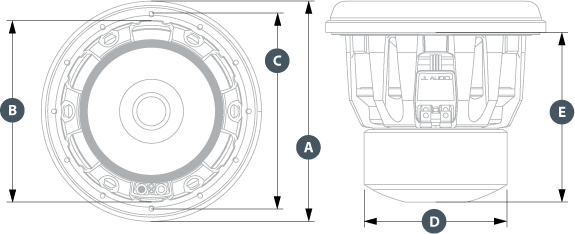
- Nominal Diameter 10.0 in / 250 mm
- Overall Diameter (A) 10.5 in / 267 mm
- Mounting Hole Diameter (B) 8.74 in / 222 mm
- Bolt Hole Circle Diameter (C) 9.34 in / 237 mm
- Motor Outer Diameter (D) 6.55 in / 166 mm
- Mounting Depth (E) 8.0 in / 203 mm
- Driver Displacement 0.09 cu ft / 2.5 L
- Net Weight 30 lb / 13.6 kg
- Free Air Resonance (Fs) 30.6 Hz
- Electrical “Q” (Qes) 0.578
- Mechanical “Q” (Qms) 7.647
- Total Speaker “Q” (Qts) 0.537
- Equivalent Compliance (Vas) 1.28 cu ft / 36.1 L
- One-Way Linear Excursion (Xmax)* 0.9 in / 23 mm
- Reference Efficiency (no) 0.17%
- Efficiency (1 W / 1 m)** 84.3 dB SPL
- Effective Piston Area (Sd) 59.8 sq in / 0.0386 sq m
- DC Resistance (Re) 2.75 Ω
Technology
 Dynamic Motor Analysis - DMA Optimized Motor
Summary:
JL Audio's proprietary Dynamic Motor Analysis system is a powerful suite of FEA-based modeling systems, first developed by JL Audio in 1997 and refined over the years to scientifically address the issue of speaker motor linearity. This leads to vastly reduced distortion and faithfully reproduced transients... or put simply: tight, clean, articulate bass.
Detailed Information:
Since 1997, JL Audio has been at the forefront of Finite Element Analysis-based modeling of loudspeaker motors and suspensions. This research is aimed at decoding what we refer to as the "Loudspeaker Genome"... a project aimed at understanding the true behavior of loudspeakers under power and in motion. A major component of this integrated system is DMA (Dynamic Motor Analysis). Starting with the 15W3 and the W7 Subwoofers in the late 1990's and early 2000's, DMA has played an important role in the design of all JL Audio woofers sold today, including our component woofers.
DMA is a Finite Element Analysis (FEA)-based system, meaning that it takes a large, complex problem, breaks it down into small solution elements for analysis and then assembles the data to form an accurate, "big-picture" solution. DMA's breakthrough is that it actually considers the effects of power through the coil as well as coil/cone position within the framework of a time-domain analysis. This gives us a highly accurate model of a speaker's actual behavior under real power, something that the traditional Thiele-Small models or other low power measurements cannot do. Because DMA does not rely on a steady-state model, it is able to consider shifts in the circuit elements being analyzed. These modeling routines are intense, requiring hours to run for a whole speaker.
DMA is able to analyze the real effects of fluctuating power and excursion upon the magnetic circuit of the motor, specifically the dynamic variations of the "fixed" magnetic field. This delivers intensely valuable information compared to traditional modeling, which assumes that the "fixed" field produced in the air gap by the magnet and the motor plates is unchanging. DMA not only shows that this "fixed" field changes in reaction to the magnetic field created by current flowing through the voice coil, but it helps our engineers arrive at motor solutions that minimize this instability. Analyzing this behavior is critical to understanding the distortion mechanisms of a speaker motor and sheds light on the aspects of motor design that determine truly linear behavior:
- Linear motor force over the speaker's operational excursion range
- Consistent motor force with both positive and negative current through the coil
- Consistent motor force at varying applied power levels
Our ability to fully analyze these aspects of motor behavior allows our transducer engineers to make critical adjustments to motor designs that result in extremely linear, highly stable dynamic loudspeaker motor systems.
The payoff is reduced distortion, improved transient performance and stellar sound quality.

W-Cone (U.S. Patent #6,496,590)
Summary:
The W-Cone is a unit-body cone assembly that delivers astonishing cone stiffness with minimal mass. The shape also provides superb torsional rigidity, which is critical to maintaining voice coil alignment at the suspension limits.
Detailed Information:
The more excursion and motor force a speaker has, the more important cone rigidity becomes. The acceleration forces are extreme, requiring the cone to withstand rapid changes in speed and direction without deformation. Deformation not only leads to distortion, but can also affect the speaker's mechanical integrity by allowing the voice coil to go out of alignment and rub on the top-plate and the pole-piece of the motor.
There are several approaches to enhancing cone rigidity. The obvious ones are using a thicker material and/or a stiffer material. In recent years, several manufacturers have used composite cone materials (Kevlar®, fiberglass, etc.) or metals (aluminum, magnesium, titanium alloys). The use of these exotic materials is typically accompanied by marketing claims that the material chosen has exceptional stiffness-to-mass characteristics. These are true statements, but can be misleading. While these materials have excellent stiffness-to-mass properties (compared to paper or poly), they are not lighter than paper or poly in practice. This means that their use accepts the compromise of added moving mass on the design. This leads to efficiency penalties and suspension complications (it's harder to keep a heavy mass aligned properly).
A simple poly cone diaphragm, while sufficient for lower power designs, would not remain rigid under the demands that the W7 design requires. Our engineering team knew that high levels of cone rigidity would be needed, but they focused on achieving rigidity without a huge weight penalty. This ultimately led to the design we call the W-Cone. The W-Cone assembly achieves its rigidity through architectural means, rather than through inherently stiff materials. The design addresses the stiffness issue by using two lightweight mineral-filled polypropylene skins, bonded together at the perimeter and the center of the assembly. The lower skin's cross-section is shaped like a 'W', hence the name, and provides incredible rigidity when bonded to the dished upper skin. The effect is not unlike the trusses of a bridge or the unit-body construction of a modern automobile. In addition to the overall rigidity benefit, the lower skin's shape distributes the force generated by the coil and motor more evenly than a typical diaphragm. The force is not only applied to the apex but also distributed to the perimeter of the outer diaphragm for more linear behavior. A further benefit of the W-Cone is that the upper skin (the one in contact with the listening environment), is isolated from the high air-pressure gradients of the enclosure, further reducing deformation (and distortion).
As a point of comparison, the W-Cone assembly of a 12W7 is 32% lighter than a typical aluminum-alloy 12-inch cone. If analyzed in terms of weight per square inch of piston area, the W7 cone-body weighs 1.24g/sq.in., compared to 1.45g/sq.in. for an aluminum-alloy cone and 1.66g/sq.in. for a titanium-alloy cone.
So why polypropylene" As stated above, our patented W-Cone technology achieves all of the benefits of more exotic materials while
better suiting the unique nature of the W7. Since the W7 surround is detachable, the moving system (including the diaphragm) is
subject to mechanical stress unseen in conventional designs. Because the user can tug on the cone while manipulating the surround, the
cone must be able to handle this without buckling or deforming. Paper, metal or brittle composite cones would not handle this well.
Our two-skin unit-body cone design achieves outstanding axial and torsional stiffness to withstand all kinds of abuse, and will remain
largely unaffected and unblemished.
 Elevated Frame Cooling (U.S. Patent #6,219,431 & #6,229,902)
Summary:
JL Audio's patented Elevated Frame Cooling design delivers cool air through slots directly above the top-plate to the voice coil of the speaker. This not only enhances power handling, but also sound quality by minimizing dynamic parameter shifts and power compression.
Detailed Information:
Many speakers employ venting techniques to enhance voice coil cooling. This is typically accomplished by having big holes in the sides of the frame just below the spider attachment shelf. While it provides a modest cooling benefit, this low-velocity air-flow does not blow directly or strongly on the voice coil.
Our patented design improves upon this cooling technique in a number of ways. By elevating the frame above the top-plate of the motor (via stand-offs integrated into the bottom of the frame) a narrow, high-velocity air-path is created between the bottom surface of the frame and the top surface of the top-plate. This air path leads directly to the voice coil and then turns upward into the spider air cavity. By utilizing the pumping action of the spider through this focused air path, a large volume of cool air hits the coil windings directly.
Another important benefit is that the upper surface of the top-plate (one of the speaker's hottest parts) is directly exposed to
cooling air flow, whereas on a conventional design it is isolated from the air flow by the lower flange of the frame. The elevated
frame technology greatly increases thermal power handling, reduces compression effects and does so without any additional parts.

Floating Cone Attach Method - FCAM™ (U.S. Patent #6,501,844)
Summary:
This assembly technique, conceived by JL Audio, ensures proper surround geometry in the assembled speaker for better excursion control
and dynamic voice coil alignment.
Detailed Information:
JL Audio's patented FCAM™ technology is an innovative method of bonding the surround/cone assembly to the voice coil former/spider assembly. This feature helps ensure concentricity of the surround, spider and voice coil without torquing the suspension to achieve it. This allows for the inevitable, slight variations in production part dimensions without having them negatively impact the integrity of the suspension and coil-centering at high excursions.
 OverRoll Surround
Summary:
By utilizing space wasted in conventional speakers, this ground-breaking innovation controls the W7's massive excursion without sacrificing precious cone area.
Detailed Information:
One of the first things you notice about a W7 is that something is "missing"... the mounting flange. Of course, this is actually not the case. The mounting flange is simply hidden beneath the surround and is made accessible for mounting purposes by detaching the outer edge of the surround and moving the roll to the inside (a pretty neat little trick). Apart from the obvious benefits of amazing your friends as you pull the surround off your speaker, there is a serious technical issue that led us in this design direction: Effective Piston Area ("Sd"). This is essentially the speaker's "cylinder bore", to use an automotive engine analogy, and is calculated by measuring the diameter of the diaphragm including one-half of the surround roll-width. In other words, from the top- center of the surround on one side to top-center of the surround on the other side.
The displacement capability of a speaker is determined by this piston area times the speaker's excursion capability. Displacement of air is directly linked to output potential. Therefore, the more air a speaker can ultimately displace, the louder it can play. That being said, there is a big difference between piston area and excursion: piston area doesn't need power to make it happen. This means that by making a larger piston, you are directly improving displacement for a given amount of excursion and, therefore, making your speaker more efficient. This is not the only factor that governs efficiency, but it is a major one.
To make a speaker have more excursion capability not only requires a motor design that can deliver more stroke, but also requires a surround rugged enough to handle the demands of longer excursions and controlled enough to keep everything lined up properly. If the surround's roll-width is not adequately large, its behavior (compliance) is not linear over the useful stroke of the woofer and it is more likely to fatigue and fail. For this reason, speakers with longer excursion capability generally need larger surround rolls (we won't comment on the ones that use large rolls strictly for cosmetic effect).
The problem with big surrounds is that they begin to encroach on the effective piston area of the driver. For example, a typical 12- inch woofer with a medium-sized roll has an effective piston area of 81.52 square inches. Compare this to a fat-surround 12-inch woofer which has a piston area of 69.07 square inches (15.2 % less effective piston area than the medium-size roll.) To overcome this loss, the fat-surround woofer has to produce more excursion to displace the same air as the woofer with the medium surround (and will require more power to do so).
OverRoll™ technology neatly sidesteps this compromise by allowing us to make full use of the entire footprint of the speaker, placing the surround further to the outside than in a conventional woofer. This means that we can use a large roll for all its benefits without sacrificing cone area (in fact, the 12W7 has 1% more piston area than the medium-surround conventional woofer). By maximizing the effective piston/total footprint ratio, we can deliver more output for a given excursion and outside frame diameter. This means that the prodigious excursion advantage of the W7 can be put to full use enhancing output, rather than making up for lost piston area.
The technology also provides a geometry advantage on the outside edge of the surround roll, allowing for more linear operation. A further benefit is that the mounting holes are inherently sealed by the surround, resulting in an improved box seal.
 Radially Cross-Drilled Pole-Piece (U.S. Patent #6,243,479)
Summary:
This innovative venting system greatly enhances thermal dissipation and power handling by directing air flow onto the voice coil former, working in conjunction with the Elevated Frame cooling technology to effectively remove heat from the voice coil. This improves power handling and reduces power compression effects, leading to more linear performance.
Detailed Information:
This technology differs from a conventionally vented pole-piece in that the air flow is capped off at the top of the pole-piece and directed through machined holes on the outer wall of the pole-piece to the region directly behind the voice coil. The top portion of the pole-piece is smaller in outside diameter where the holes vent and helps create a high-volume, high-velocity airflow path between the inner-coil cavity and the ambient air of the enclosure.This helps remove super-heated air that is trapped between the coil former and pole-piece on a conventional design, leading to a dramatic improvement in cooling efficiency, especially at high excursions.
 Engineered Lead-Wire System (U.S. Patent #7,356,157)
Summary:
Carefully engineered lead-wire design and attachments ensure controlled, quiet lead-wire behavior under the most extreme excursion demands.
Detailed Information:
Managing the lead-wires on a long-excursion woofer is one of the trickier aspects of its mechanical design. To address this, many long-excursion woofers today rely on a simple solution that weaves the lead-wires into the spider (rear suspension) of the driver.
The biggest problem with this approach is that spider limiting behavior plays a hugely important role a woofer's performance. Lead- wires that are attached or woven into the spider material can alter the spider's "stretching" behavior. The tinsel wire naturally has less 'give' than the fabric material of the spider leading to asymmetrical spider behavior and non-uniform stress distribution around the spider circumference. The wire attachment points can also cause localized pulling and tearing forces at the spider's excursion limits. As such, longevity becomes a major concern and makes the woven-in design less than ideal for very long-excursion designs.
While a traditional 'flying lead' design does not compromise spider linearity or radial stability, it creates its own challenges on a long-excursion woofer. Managing the 'whipping' behavior of the wire and making sure it does not contact the cone or spider is one challenge. Another is ensuring that the leads do not short one another or the frame of the woofer.
To overcome these issues, JL Audio's engineered flying lead-wires work in conjunction with carefully engineered entry and exit support structures molded into the terminals and the voice coil collar. Some models also feature jacketed lead-wires to further reduce the likelihood of shorting and fatigue. The result is flawless high-excursion lead-wire behavior, with outstanding reliability and none of the compromises inherent to a woven-in lead wire system. Building woofers this way requires much more labor and parts complexity than the simpler woven-in approach, but the payoff is in reduced distortion, reduced mechanical noise and improved reliability.
 Built in U.S.A. with Global Components
Summary:
JL Audio's Miramar, Florida loudspeaker production facility is one of the most advanced in the world.
Detailed Information:
At a time when most audio products are built overseas, JL Audio’s commitment to in-house loudspeaker production continues to grow. To pull this off in a competitive world market, our production engineering team has created one of the world’s most advanced loudspeaker assembly facilities and established a global network of quality component suppliers who build to our specifications. This, combined with our commitment to state-of-the-art assembly technology, allows our skilled workforce to efficiently build JL Audio products to extremely high quality standards, right here in the U.S.A.
Since most of our premium loudspeakers incorporate proprietary, patented technologies requiring specific assembly techniques, we find it is vital that the people who designed them have close access to the people manufacturing them. The following JL Audio products are built in our Miramar, Florida factory, with global components:
- Subwoofer Drivers: W7, W6v3, TW5v2, TW3, TW1, W3v3
- Enclosed Car Subwoofers: Stealthbox®, PowerWedge™, ProWedge™, H.O. Wedge™ & MicroSub™ Enclosed Subwoofers
- Marine Loudspeakers, Marine Subwoofer Drivers and Marine Enclosed Loudspeakers
- Home Subwoofers: Dominion™, E-Sub, Fathom® and Gotham®
Available for Shipping Only
Hide Details
Show Details
Hide Details
Show Details
JL Audio 10W7AE-3 10" Subwoofer Driver 3 Ohm Sku 92114 OverviewIf you are seeking reference-grade...

JL Audio 12TW3-D8 Thin-Line 12" Subwoofer
- 400 Watts RMS
- Dual 8-Ohm Voice Coils
- Mica-Filled Polypropylene Cone
Available for Shipping Only
Hide Details
Show Details
Hide Details
Show Details
JL Audio 10TW3-D8 Thin-Line 12" Subwoofer Building on the core technology of our TW5 thin-line...

JL Audio 12W0v3-4 12 Inch Subwoofer Driver 4 ohm
JL Audio 12W0v3-4
12" Subwoofer Driver 4 ohm sku 92166Overview
The 12W0v3 is a rugged performer with excellent efficiency, excursion capability and linearity. Its overall performance envelope that puts it right at the top of its price class. It features a beefy 2 in. diameter voice coil and our patented Elevated Frame Cooling design for enhanced power handling and reliability.The 12W0v3 is best used with amplifier power in the 75W - 300W range and is optimized to operate in a moderately sized 1.375 cu. ft. (38.9 l) sealed enclosure, or a 1.75 cu. ft. (49.6 l) ported enclosure.
Specifications
General Specifications
- Continuous Power Handling (RMS) 300 W
- Recommended Amplifier Power (RMS) 75 - 300 W
- Nominal Impedance (Znom) 4 Ω

- Nominal Diameter 12.0 in / 300 mm
- Overall Diameter (A) 12.52 in / 318 mm
- Mounting Hole Diameter (B) 11.0625 in / 281 mm
- Bolt Hole Circle Diameter (C) 11.7 in / 297 mm
- Motor Outer Diameter (D) 5.05 in / 128 mm
- Mounting Depth (E) 5.40 in / 137 mm
- Driver Displacement 0.048 cu ft / 1.36 L
- Net Weight 8.11 lb / 3.68 kg
- Free Air Resonance (Fs) 28.43 Hz
- Electrical “Q” (Qes) 0.715
- Mechanical “Q” (Qms) 10.709
- Total Speaker “Q” (Qts) 0.67
- Equivalent Compliance (Vas) 2.530 cu ft / 71.64 L
- One-Way Linear Excursion (Xmax)* 0.45 in / 11.4 mm
- Reference Efficiency (no) 0.22%
- Efficiency (1 W / 1 m)** 85.64 dB SPL
- Effective Piston Area (Sd) 74.509 sq in / 0.0481 sq m
- DC Resistance (Re) 4.280 Ω

- Wall Thickness 0.75 in / 19 mm
- Front Baffle Thickness 0.75 in / 19 mm
- Volume (net int.) 1.375 cu ft / 38.94 L
- External Width (W) 16 in / 406 mm
- External Height (H) 19 in / 483 mm
- External Depth (D) 11.75 in / 298 mm
- F3 36.0 Hz
- Fc 47.91 Hz
- Qtc 1.179

- Wall Thickness 0.75 in / 19 mm
- Front Baffle Thickness 0.75 in / 19 mm
- Volume (net int.) 1.75 cu ft / 49.6 L
- External Width (W) 17.5 in / 445 mm
- External Height (H) 14.75 in / 375 mm
- External Depth (D) 16.25 in / 413 mm
- Internal Port Diameter (ID) 3 in / 76 mm
- Port Length (L) 14 in / 356 mm
- Tuning Frequency (Fb) 26 Hz
- F3 30.8 Hz
Technology
Dynamic Motor Analysis - DMA Optimized Motor
Summary:JL Audio's proprietary Dynamic Motor Analysis system is a powerful suite of FEA-based modeling systems, first developed by JL Audio in 1997 and refined over the years to scientifically address the issue of speaker motor linearity. This leads to vastly reduced distortion and faithfully reproduced transients... or put simply: tight, clean, articulate bass. Detailed Information:
Since 1997, JL Audio has been at the forefront of Finite Element Analysis-based modeling of loudspeaker motors and suspensions. This research is aimed at decoding what we refer to as the "Loudspeaker Genome"... a project aimed at understanding the true behavior of loudspeakers under power and in motion. A major component of this integrated system is DMA (Dynamic Motor Analysis). Starting with the 15W3 and the W7 Subwoofers in the late 1990's and early 2000's, DMA has played an important role in the design of all JL Audio woofers sold today, including our component woofers. DMA is a Finite Element Analysis (FEA)-based system, meaning that it takes a large, complex problem, breaks it down into small solution elements for analysis and then assembles the data to form an accurate, "big-picture" solution. DMA's breakthrough is that it actually considers the effects of power through the coil as well as coil/cone position within the framework of a time-domain analysis. This gives us a highly accurate model of a speaker's actual behavior under real power, something that the traditional Thiele-Small models or other low power measurements cannot do. Because DMA does not rely on a steady-state model, it is able to consider shifts in the circuit elements being analyzed. These modeling routines are intense, requiring hours to run for a whole speaker. DMA is able to analyze the real effects of fluctuating power and excursion upon the magnetic circuit of the motor, specifically the dynamic variations of the "fixed" magnetic field. This delivers intensely valuable information compared to traditional modeling, which assumes that the "fixed" field produced in the air gap by the magnet and the motor plates is unchanging. DMA not only shows that this "fixed" field changes in reaction to the magnetic field created by current flowing through the voice coil, but it helps our engineers arrive at motor solutions that minimize this instability. Analyzing this behavior is critical to understanding the distortion mechanisms of a speaker motor and sheds light on the aspects of motor design that determine truly linear behavior:
- Linear motor force over the speaker's operational excursion range
- Consistent motor force with both positive and negative current through the coil
- Consistent motor force at varying applied power levels
The payoff is reduced distortion, improved transient performance and stellar sound quality.
Elevated Frame Cooling (U.S. Patent #6,219,431 & #6,229,902)
Summary:JL Audio's patented Elevated Frame Cooling design delivers cool air through slots directly above the top-plate to the voice coil of the speaker. This not only enhances power handling, but also sound quality by minimizing dynamic parameter shifts and power compression. Detailed Information:
Many speakers employ venting techniques to enhance voice coil cooling. This is typically accomplished by having big holes in the sides of the frame just below the spider attachment shelf. While it provides a modest cooling benefit, this low-velocity air-flow does not blow directly or strongly on the voice coil. Our patented design improves upon this cooling technique in a number of ways. By elevating the frame above the top-plate of the motor (via stand-offs integrated into the bottom of the frame) a narrow, high-velocity air-path is created between the bottom surface of the frame and the top surface of the top-plate. This air path leads directly to the voice coil and then turns upward into the spider air cavity. By utilizing the pumping action of the spider through this focused air path, a large volume of cool air hits the coil windings directly. Another important benefit is that the upper surface of the top-plate (one of the speaker's hottest parts) is directly exposed to cooling air flow, whereas on a conventional design it is isolated from the air flow by the lower flange of the frame. The elevated frame technology greatly increases thermal power handling, reduces compression effects and does so without any additional parts.
Out of stock
Hide Details
Show Details
Hide Details
Show Details
JL Audio 12W0v3-4 12" Subwoofer Driver 4 ohm sku 92166 Overview The 12W0v3 is a...

Out of stock
Hide Details
Show Details
Hide Details
Show Details
JL Audio 12W1v3-4 12" Subwoofer The 12W1v3 is a lightweight 12-inch driver with excellent performance...

JL Audio 12W3v3-2 12 Inch Subwoofer Driver
JL Audio 12W3v3-2
12" Subwoofer Driver Sku 92153 OverviewThis powerhouse 12-inch driver delivers potent performance and world-class sound quality in medium power applications. Several exclusive JL Audio technologies and proprietary assembly techniques are applied to the 12W3v3 to enhance linearity and reliability.
The 12W3v3-2 is best used with amplifier power in the 150W - 500W range and is optimized to operate in a compact 1.25 cu. ft. (35.4 l) sealed enclosure, or a 1.75 cu. ft. (49.6 l) ported enclosure.
Specifications
General Specifications
- Continuous Power Handling (RMS) 500 W
- Recommended Amplifier Power (RMS) 150 - 500 W
- Nominal Impedance (Znom) 2 Ω
Physical Specifications
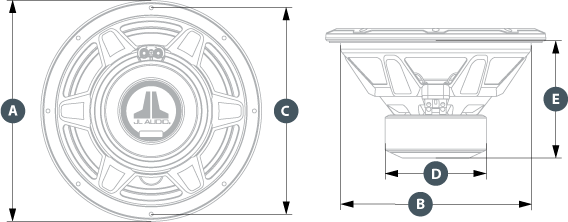
- Nominal Diameter 12.0 in / 300 mm
- Overall Diameter (A) 12.5 in / 318 mm
- Mounting Hole Diameter (B) 11.0625 in / 281 mm
- Bolt Hole Circle Diameter (C) 11.7 in / 297 mm
- Motor Outer Diameter (D) 5.5 in / 140 mm
- Mounting Depth (E) 6.65 in / 169 mm
- Driver Displacement 0.071 cu ft / 2.01 L
- Net Weight 14.50 lb / 6.58 kg
Parameters
- Free Air Resonance (Fs) 27.97 Hz
- Electrical “Q” (Qes) 0.534
- Mechanical “Q” (Qms) 7.678
- Total Speaker “Q” (Qts) 0.5
- Equivalent Compliance (Vas) 2.806 cu ft / 79.47 L
- One-Way Linear Excursion (Xmax)* 0.510 in / 13.0 mm
- Reference Efficiency (no) 0.31%
- Efficiency (1 W / 1 m)** 87.15 dB SPL
- Effective Piston Area (Sd) 80.600 sq in / 0.0520 sq m
- DC Resistance (Re) 1.658 Ω
Technology
Dynamic Motor Analysis - DMA Optimized Motor
Summary:
JL Audio's proprietary Dynamic Motor Analysis system is a powerful suite of FEA-based modeling systems, first developed by JL Audio in 1997 and refined over the years to scientifically address the issue of speaker motor linearity. This leads to vastly reduced distortion and faithfully reproduced transients... or put simply: tight, clean, articulate bass.
Detailed Information:
Since 1997, JL Audio has been at the forefront of Finite Element Analysis-based modeling of loudspeaker motors and suspensions. This research is aimed at decoding what we refer to as the "Loudspeaker Genome"... a project aimed at understanding the true behavior of loudspeakers under power and in motion. A major component of this integrated system is DMA (Dynamic Motor Analysis). Starting with the 15W3 and the W7 Subwoofers in the late 1990's and early 2000's, DMA has played an important role in the design of all JL Audio woofers sold today, including our component woofers.
DMA is a Finite Element Analysis (FEA)-based system, meaning that it takes a large, complex problem, breaks it down into small solution elements for analysis and then assembles the data to form an accurate, "big-picture" solution. DMA's breakthrough is that it actually considers the effects of power through the coil as well as coil/cone position within the framework of a time-domain analysis. This gives us a highly accurate model of a speaker's actual behavior under real power, something that the traditional Thiele-Small models or other low power measurements cannot do. Because DMA does not rely on a steady-state model, it is able to consider shifts in the circuit elements being analyzed. These modeling routines are intense, requiring hours to run for a whole speaker.
DMA is able to analyze the real effects of fluctuating power and excursion upon the magnetic circuit of the motor, specifically the dynamic variations of the "fixed" magnetic field. This delivers intensely valuable information compared to traditional modeling, which assumes that the "fixed" field produced in the air gap by the magnet and the motor plates is unchanging. DMA not only shows that this "fixed" field changes in reaction to the magnetic field created by current flowing through the voice coil, but it helps our engineers arrive at motor solutions that minimize this instability. Analyzing this behavior is critical to understanding the distortion mechanisms of a speaker motor and sheds light on the aspects of motor design that determine truly linear behavior:
- Linear motor force over the speaker's operational excursion range
- Consistent motor force with both positive and negative current through the coil
- Consistent motor force at varying applied power levels
Our ability to fully analyze these aspects of motor behavior allows our transducer engineers to make critical adjustments to motor designs that result in extremely linear, highly stable dynamic loudspeaker motor systems.
The payoff is reduced distortion, improved transient performance and stellar sound quality.
Elevated Frame Cooling (U.S. Patent #6,219,431 & #6,229,902)
Summary:JL Audio's patented Elevated Frame Cooling design delivers cool air through slots directly above the top-plate to the voice coil of the speaker. This not only enhances power handling, but also sound quality by minimizing dynamic parameter shifts and power compression.
Detailed Information:
Many speakers employ venting techniques to enhance voice coil cooling. This is typically accomplished by having big holes in the sides of the frame just below the spider attachment shelf. While it provides a modest cooling benefit, this low-velocity air-flow does not blow directly or strongly on the voice coil.
Our patented design improves upon this cooling technique in a number of ways. By elevating the frame above the top-plate of the motor (via stand-offs integrated into the bottom of the frame) a narrow, high-velocity air-path is created between the bottom surface of the frame and the top surface of the top-plate. This air path leads directly to the voice coil and then turns upward into the spider air cavity. By utilizing the pumping action of the spider through this focused air path, a large volume of cool air hits the coil windings directly.
Another important benefit is that the upper surface of the top-plate (one of the speaker's hottest parts) is directly exposed to cooling air flow, whereas on a conventional design it is isolated from the air flow by the lower flange of the frame. The elevated frame technology greatly increases thermal power handling, reduces compression effects and does so without any additional parts.
Floating Cone Attach Method - FCAM™ (U.S. Patent #6,501,844)
Summary:This assembly technique, conceived by JL Audio, ensures proper surround geometry in the assembled speaker for better excursion control and dynamic voice coil alignment.
Detailed Information:
JL Audio's patented FCAM™ technology is an innovative method of bonding the surround/cone assembly to the voice coil former/spider assembly. This feature helps ensure concentricity of the surround, spider and voice coil without torquing the suspension to achieve it. This allows for the inevitable, slight variations in production part dimensions without having them negatively impact the integrity of the suspension and coil-centering at high excursions.

Vented Reinforcement Collar
Summary:JL Audio's Vented Reinforcement Collar (VRC®) improves the rigidity and stability of the cone/spider/voice coil junction and directs airflow over the voice coil windings for improved thermal performance.
Detailed Information:
The Vented Reinforcement Collar (VRC®) is a composite structure that addresses two issues related to reliability.
By reinforcing the critical junction between the cone, voice coil and spider, the VRC greatly reduces failures due to glue breakdown or material weakness. It does this by greatly increasing adhesive contact area and providing stress relief to the spider material at excursion extremes.
Subwoofer VRC
The VRC™ also features slots that facilitate air flow directly onto the voice coil windings. This reduces thermal compression effects and enhances reliability.
Current versions of the VRC™ also incorporate lead-wire strain relief structures to improve mechanical reliability.

Insert Molded Suspension / Coil / Terminal Sub-Assembly (U.S. Patent #7,379,558)
Summary:Spiders, voice coils, terminals and lead wires are preassembled, using a patent-pending process, onto a composite carrier for improved precision and reliability.
Detailed Information:
A conventional speaker is assembled in layers. In other words, multiple parts are assembled and glued sequentially into the basket, leading to stacking of tolerances and making it difficult to achieve optimal assembly precision.
JL Audio's patent-pending insert-molded spider carrier permanently bonds the spider to a mechanically robust carrier that also incorporates the terminal assembly and lead wire strain relief features for enhanced reliability and optimal alignment of parts. This subassembly is assembled outside the speaker basket, for optimum alignment and glue-joint integrity. The benefit is a more precisely built, more mechanically sound loudspeaker.

Customizable Trim Ring (U.S. Patent #D480,709)
Summary:This removable ring can be painted to match the installation theme and directly receives JL Audio grille mesh inserts (sold separately).
Detailed Information:
This ABS trim ring is molded in black, but that doesn't mean it has to stay that way. By custom painting it, you can match your installation theme and create a personalized look.
Specifically-designed grille mesh inserts are available separately and fit into the inner diameter of the trim ring.
Helpful Tip: Installing the grille mesh inserts is much easier before mounting the woofer into the enclosure.
Engineered Lead-Wire System (U.S. Patent #7,356,157)
Summary:Carefully engineered lead-wire design and attachments ensure controlled, quiet lead-wire behavior under the most extreme excursion demands.
Detailed Information:
Managing the lead-wires on a long-excursion woofer is one of the trickier aspects of its mechanical design. To address this, many long-excursion woofers today rely on a simple solution that weaves the lead-wires into the spider (rear suspension) of the driver.
The biggest problem with this approach is that spider limiting behavior plays a hugely important role a woofer's performance. Lead-wires that are attached or woven into the spider material can alter the spider's "stretching" behavior. The tinsel wire naturally has less 'give' than the fabric material of the spider leading to asymmetrical spider behavior and non-uniform stress distribution around the spider circumference. The wire attachment points can also cause localized pulling and tearing forces at the spider's excursion limits. As such, longevity becomes a major concern and makes the woven-in design less than ideal for very long-excursion designs.
While a traditional 'flying lead' design does not compromise spider linearity or radial stability, it creates its own challenges on a long-excursion woofer. Managing the 'whipping' behavior of the wire and making sure it does not contact the cone or spider is one challenge. Another is ensuring that the leads do not short one another or the frame of the woofer.
To overcome these issues, JL Audio's engineered flying lead-wires work in conjunction with carefully engineered entry and exit support structures molded into the terminals and the voice coil collar. Some models also feature jacketed lead-wires to further reduce the likelihood of shorting and fatigue. The result is flawless high-excursion lead-wire behavior, with outstanding reliability and none of the compromises inherent to a woven-in lead wire system. Building woofers this way requires much more labor and parts complexity than the simpler woven-in approach, but the payoff is in reduced distortion, reduced mechanical noise and improved reliability.
Built in U.S.A. with Global Components
Summary:JL Audio's Miramar, Florida loudspeaker production facility is one of the most advanced in the world.
Detailed Information:
At a time when most audio products are built overseas, JL Audio’s commitment to in-house loudspeaker production continues to grow. To pull this off in a competitive world market, our production engineering team has created one of the world’s most advanced loudspeaker assembly facilities and established a global network of quality component suppliers who build to our specifications.
This, combined with our commitment to state-of-the-art assembly technology, allows our skilled workforce to efficiently build JL Audio products to extremely high quality standards, right here in the U.S.A. Since most of our premium loudspeakers incorporate proprietary, patented technologies requiring specific assembly techniques, we find it is vital that the people who designed them have close access to the people manufacturing them. The following JL Audio products are built in our Miramar, Florida factory, with global components:
- Subwoofer Drivers: W7, W6v3, TW5v2, TW3, TW1, W3v3
- Enclosed Car Subwoofers: Stealthbox®, PowerWedge™, ProWedge™, H.O. Wedge™ & MicroSub™ Enclosed Subwoofers
- Marine Loudspeakers, Marine Subwoofer Drivers and Marine Enclosed Loudspeakers
- Home Subwoofers: Dominion™, E-Sub, Fathom® and Gotham®
Available for Shipping Only
Hide Details
Show Details
Hide Details
Show Details
JL Audio 12W3v3-2 12" Subwoofer Driver Sku 92153 OverviewThis powerhouse 12-inch driver delivers potent performance...

JL Audio 12W3v3-4 12" Subwoofer
- 500 Watts RMS
- Dual 4-Ohm Voice Coils
- Mineral-Filled Polypropylene Cone
In stock
Hide Details
Show Details
Hide Details
Show Details
JL Audio 12W3v3-4 12" Subwoofer Overview This powerhouse 12-inch driver delivers potent performance and world-class...

JL Audio 12W6v3-D4 12" Subwoofer
- 600 Watts RMS
- Dual 4-Ohm Voice Coils
- Mineral-Filled Polypropylene Cone
In stock
Hide Details
Show Details
Hide Details
Show Details
JL Audio 12W6v3-D4 12" Subwoofer If you are seeking intensely powerful sub-bass that compromises nothing...

JL Audio 12W7AE-3 12 Inch Anniversary Edition Subwoofer
- Satin Black Powdercoated Basket
- Anniversary Edition Cone Badge and Terminal Label
- 1000 watt, 3 ohm Driver
Available for Shipping Only
Hide Details
Show Details
Hide Details
Show Details
JL Audio 12W7AE-3 10th Anniversary Edition - W7 12-inch Subwoofer Driver (1000 W, 3 Ω)...

JL Audio 13TW5v2-4 13.5 Inch Subwoofer Driver
JL Audio 13TW5v2-4
13.5" Subwoofer Driver 600 watt 4 OhmOverview
We couldn’t leave the ultimate thin woofer alone... we had to make it even better. Our patented thin-line woofer technology compresses the architecture of the 13TW5v2 using a “concentric tube” structure that supports the 7-inch diameter voice coil and the suspension attachments. This permits placement of the large motor structure much further forward in the speaker than with conventional designs, while allowing excellent linear excursion capability and mechanical stability. To unleash even more performance from this technology, the v2 improves upon the original 13TW5 with 13% greater linear excursion capability. The cast alloy chassis has also been modified for greater strength and the redesigned motor now features an annular vent. The v2 is also available in single 2 ohm and single 4 ohm voice coil versions to fit a wide range of applications. In keeping with its “tight-spaces” mission, the 13TW5v2 is optimized for enclosures that are far smaller than most 12-inch woofers require and only a bit larger than the air space needs of a typical, small-box 10-inch woofer. The mounting system is designed to fit in about the same footprint as a typical 12-inch woofer. The 13TW5v2 is best used with amplifier power in the 250W - 600W range and is optimized to operate in a 0.80 cu. ft. (22.7 l) sealed enclosure. Never has such high-quality sub-bass been possible in the most challenging installation applications.Specifications
General Specifications
- Continuous Power Handling (RMS) 600 W
- Recommended Amplifier Power (RMS) 250 - 600 W
- Nominal Impedance (Znom) 2 Ω

- Nominal Diameter 13.5 in / 345 mm
- Overall Diameter (A) A1: 14.2 in / 361mm
- A2: 13.0 in / 330 mm
- Mounting Hole Diameter (B) 12.5 in / 318 mm
- Bolt Hole Circle Diameter (C) 13.5 in / 343 mm
- Motor Outer Diameter (D) 6.75 in / 171 mm
- Mounting Depth (E) 2.625 in / 67 mm
- Driver Displacement 0.052 cu ft / 1.47 L
- Net Weight 20.5 lb / 9.3 kg
- Free Air Resonance (Fs) 27.61 Hz
- Electrical “Q” (Qes) 0.553
- Mechanical “Q” (Qms) 10.692
- Total Speaker “Q” (Qts) 0.526
- Equivalent Compliance (Vas) 2.13 cu ft / 60.31 L
- One-Way Linear Excursion (Xmax)* 0.433 in / 11 mm
- Reference Efficiency (no) 0.23%
- Efficiency (1 W / 1 m)** 85.63 dB SPL
- Effective Piston Area (Sd) 98.26 sq in / 0.0634 sq m
- DC Resistance (Re) 3.513 Ω
Technology
Dynamic Motor Analysis - DMA Optimized Motor
Summary:JL Audio's proprietary Dynamic Motor Analysis system is a powerful suite of FEA-based modeling systems, first developed by JL Audio in 1997 and refined over the years to scientifically address the issue of speaker motor linearity. This leads to vastly reduced distortion and faithfully reproduced transients... or put simply: tight, clean, articulate bass.
Detailed Information:
Since 1997, JL Audio has been at the forefront of Finite Element Analysis-based modeling of loudspeaker motors and suspensions. This research is aimed at decoding what we refer to as the "Loudspeaker Genome"... a project aimed at understanding the true behavior of loudspeakers under power and in motion. A major component of this integrated system is DMA (Dynamic Motor Analysis). Starting with the 15W3 and the W7 Subwoofers in the late 1990's and early 2000's, DMA has played an important role in the design of all JL Audio woofers sold today, including our component woofers. DMA is a Finite Element Analysis (FEA)-based system, meaning that it takes a large, complex problem, breaks it down into small solution elements for analysis and then assembles the data to form an accurate, "big-picture" solution. DMA's breakthrough is that it actually considers the effects of power through the coil as well as coil/cone position within the framework of a time-domain analysis. This gives us a highly accurate model of a speaker's actual behavior under real power, something that the traditional Thiele-Small models or other low power measurements cannot do. Because DMA does not rely on a steady-state model, it is able to consider shifts in the circuit elements being analyzed. These modeling routines are intense, requiring hours to run for a whole speaker. DMA is able to analyze the real effects of fluctuating power and excursion upon the magnetic circuit of the motor, specifically the dynamic variations of the "fixed" magnetic field. This delivers intensely valuable information compared to traditional modeling, which assumes that the "fixed" field produced in the air gap by the magnet and the motor plates is unchanging. DMA not only shows that this "fixed" field changes in reaction to the magnetic field created by current flowing through the voice coil, but it helps our engineers arrive at motor solutions that minimize this instability. Analyzing this behavior is critical to understanding the distortion mechanisms of a speaker motor and sheds light on the aspects of motor design that determine truly linear behavior:
Linear motor force over the speaker's operational excursion range
Consistent motor force with both positive and negative current through the coil
Consistent motor force at varying applied power levels
Our ability to fully analyze these aspects of motor behavior allows our transducer engineers to make critical adjustments to motor designs that result in extremely linear, highly stable dynamic loudspeaker motor systems.
The payoff is reduced distortion, improved transient performance and stellar sound quality.
Floating Cone Attach Method - FCAM™ (U.S. Patent #6,501,844)
Summary:This assembly technique, conceived by JL Audio, ensures proper surround geometry in the assembled speaker for better excursion control and dynamic voice coil alignment.
Detailed Information:
JL Audio's patented FCAM™ technology is an innovative method of bonding the surround/cone assembly to the voice coil former/spider assembly. This feature helps ensure concentricity of the surround, spider and voice coil without torquing the suspension to achieve it. This allows for the inevitable, slight variations in production part dimensions without having them negatively impact the integrity of the suspension and coil-centering at high excursions.
Tab-Ear Frame Design
 Summary:
This frame design feature facilitates mounting the subwoofer driver in tight spaces. Detailed Information:
By employing a tab-ear mounting system, the driver's overall outside dimensions are reduced, permitting it to be mounted in a space that is very similar to that required by the next smaller round woofer frame.
In this example, the “Tab-Ear” frame design allows a 13TW5 13.5-inch driver to fit in a space only slightly larger than a conventional 12-inch woofer requires (only 0.44 in. / 11.2 mm bigger)

Concentric Tube Suspension
Summary:Our Concentric Tube Suspension™ technology delivers unprecedented excursion in a low-profile woofer. Detailed Information:
The biggest challenge in any low-profile woofer design is to create enough mechanical clearance for the speaker to generate enough excursion to meet its output and low-frequency extension goals. Since these goals were very ambitious in the development of JL Audio's low profile woofers, achieving them required development of a new suspension architecture.
JL Audio's solution employs a molded structure which spans over the edge of the motor system, supporting the spider on the outside of the motor's boundaries and the large diameter voice coil on the inside. The large diameter voice coil permits the magnet to sit inside it, rather than surrounding the coil as is typical in most woofers.
 The concentric tube structure and the elimination of a conventional top-plate helps us place the motor system higher up into the cone body's space to further compress depth, while still permitting excellent mechanical excursion.
Built in U.S.A. with Global Components
Summary:JL Audio's Miramar, Florida loudspeaker production facility is one of the most advanced in the world. Detailed Information:
At a time when most audio products are built overseas, JL Audio’s commitment to in-house loudspeaker production continues to grow. To pull this off in a competitive world market, our production engineering team has created one of the world’s most advanced loudspeaker assembly facilities and established a global network of quality component suppliers who build to our specifications. This, combined with our commitment to state-of-the-art assembly technology, allows our skilled workforce to efficiently build JL Audio products to extremely high quality standards, right here in the U.S.A.
Since most of our premium loudspeakers incorporate proprietary, patented technologies requiring specific assembly techniques, we find it is vital that the people who designed them have close access to the people manufacturing them. The following JL Audio products are built in our Miramar, Florida factory, with global components:
- Subwoofer Drivers: W7, W6v3, TW5v2, TW3, TW1, W3v3
- Enclosed Car Subwoofers: Stealthbox®, PowerWedge™, ProWedge™, H.O. Wedge™ & MicroSub™ Enclosed Subwoofers
- Marine Loudspeakers, Marine Subwoofer Drivers and Marine Enclosed Loudspeakers
- Home Subwoofers: Dominion™, E-Sub, Fathom® and Gotham®
Out of stock
Hide Details
Show Details
Hide Details
Show Details
JL Audio 13TW5v2-4 13.5" Subwoofer Driver 600 watt 4 Ohm Overview We couldn’t leave the...

JL Audio 13W3v3-4 13.5" Subwoofer - 4 Ohms
JL Audio 13W3v3-4 13.5" Subwoofer - 4 Ohms
If you have the space, it makes a tremendous sense to maximize your subwoofer system's piston area to enhance efficiency (and output). It gets even better when the larger driver delivers additional power handling and excursion. For the preceding reasons, the 13W3v3 can be the best choice for those seeking high output with great sound quality at medium power levels. As with the smaller W3v3's, several exclusive JL Audio technologies and proprietary assembly techniques are applied to the 13W3v3 to enhance linearity and reliability. The 13W3v3-4 is best used with amplifier power in the 150W - 600W range and is optimized to operate in a moderate size 1.5 cu. ft. (42.5 l) sealed enclosure, or a 2.25 cu. ft. (63.7 l) ported enclosure. Detailed enclosure recommendations can be found in the "Specifications" tab.General Specifications

Continuous Power Handling (RMS): 600 W
Recommended Amplifier Power (RMS): 150 - 600 W
Nominal Impedance (Znom): 4 Ohms
Recommended Amplifier Power (RMS): 150 - 600 W
Nominal Impedance (Znom): 4 Ohms
Physical Specifications

Nominal Diameter: 13.5 in / 345 mm
Overall Diameter (A): 14.0 in / 356 mm
Mounting Hole Diameter (B): 12.5625 in / 319 mm
Bolt Hole Circle Diameter (C): 13.2 in / 335 mm
Motor Outer Diameter (D): 5.79 in / 147 mm
Mounting Depth (E): 7.63 in / 194 mm
Driver Displacement: 0.096 cu ft / 2.72 liters
Net Weight: 17.75 lb / 8.05 kg
Electrical “Q” (Qes): 0.465
Mechanical “Q” (Qms): 6.774
Total Speaker “Q” (Qts): 0.435
Equivalent Compliance (Vas): 4.793 cu ft / 135.74 L
One-Way Linear Excursion (Xmax)*: 0.610 in / 15.5 mm
Reference Efficiency (no): 0.37%
Efficiency (1 W / 1 m)**: 87.90 dB SPL
Effective Piston Area (Sd): 103.850 sq in / 0.0670 sq m
DC Resistance (Re): 3.569 Ohms * Xmax specifications are derived via one-way voice coil overhang method with no correction factors applied. ** Efficiency (1 W / 1 m) is not an accurate indicator of a subwoofer’s output capability and should not be used as a comparison to other subwoofers to determine which one is “louder”.
Overall Diameter (A): 14.0 in / 356 mm
Mounting Hole Diameter (B): 12.5625 in / 319 mm
Bolt Hole Circle Diameter (C): 13.2 in / 335 mm
Motor Outer Diameter (D): 5.79 in / 147 mm
Mounting Depth (E): 7.63 in / 194 mm
Driver Displacement: 0.096 cu ft / 2.72 liters
Net Weight: 17.75 lb / 8.05 kg
Parameters
Free Air Resonance (Fs): 23.66 HzElectrical “Q” (Qes): 0.465
Mechanical “Q” (Qms): 6.774
Total Speaker “Q” (Qts): 0.435
Equivalent Compliance (Vas): 4.793 cu ft / 135.74 L
One-Way Linear Excursion (Xmax)*: 0.610 in / 15.5 mm
Reference Efficiency (no): 0.37%
Efficiency (1 W / 1 m)**: 87.90 dB SPL
Effective Piston Area (Sd): 103.850 sq in / 0.0670 sq m
DC Resistance (Re): 3.569 Ohms * Xmax specifications are derived via one-way voice coil overhang method with no correction factors applied. ** Efficiency (1 W / 1 m) is not an accurate indicator of a subwoofer’s output capability and should not be used as a comparison to other subwoofers to determine which one is “louder”.
Out of stock
Hide Details
Show Details
Hide Details
Show Details
JL Audio 13W3v3-4 13.5" Subwoofer - 4 Ohms If you have the space, it makes...

JL Audio 13W3v3-4 13.5" Subwoofer Driver 600 watt 4 Ohm
JL Audio 13W3v3-4 13.5" Subwoofer Driver - 4 Ohm
Overview If you have the space, it makes a tremendous sense to maximize your subwoofer system's piston area to enhance efficiency (and output). It gets even better when the larger driver delivers additional power handling and excursion. For the preceding reasons, the 13W3v3 can be the best choice for those seeking high output with great sound quality at medium power levels. As with the smaller W3v3's, several exclusive JL Audio technologies and proprietary assembly techniques are applied to the 13W3v3 to enhance linearity and reliability. The 13W3v3-4 is best used with amplifier power in the 150W - 600W range and is optimized to operate in a moderate size 1.5 cu. ft. (42.5 l) sealed enclosure, or a 2.25 cu. ft. (63.7 l) ported enclosure. Specifications General Specifications
- Continuous Power Handling (RMS) 600 W
- Recommended Amplifier Power (RMS) 150 - 600 W
- Nominal Impedance (Znom) 4 Ω
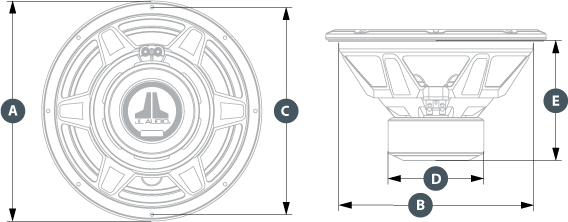
- Nominal Diameter 13.5 in / 345 mm
- Overall Diameter (A) 14.0 in / 356 mm
- Mounting Hole Diameter (B) 12.5625 in / 319 mm
- Bolt Hole Circle Diameter (C) 13.2 in / 335 mm
- Motor Outer Diameter (D) 5.79 in / 147 mm
- Mounting Depth (E) 7.63 in / 194 mm
- Driver Displacement 0.096 cu ft / 2.72 liters
- Net Weight 17.75 lb / 8.05 kg
- Free Air Resonance (Fs) 23.66 Hz
- Electrical “Q” (Qes) 0.465
- Mechanical “Q” (Qms) 6.774
- Total Speaker “Q” (Qts) 0.435
- Equivalent Compliance (Vas) 4.793 cu ft / 135.74 L
- One-Way Linear Excursion (Xmax)* 0.610 in / 15.5 mm
- Reference Efficiency (no) 0.37%
- Efficiency (1 W / 1 m)** 87.90 dB SPL
- Effective Piston Area (Sd) 103.850 sq in / 0.0670 sq m
- DC Resistance (Re) 3.569 Ω
Technology
Dynamic Motor Analysis - DMA Optimized Motor
Summary:
JL Audio's proprietary Dynamic Motor Analysis system is a powerful suite of FEA-based modeling systems, first developed by JL Audio in 1997 and refined over the years to scientifically address the issue of speaker motor linearity. This leads to vastly reduced distortion and faithfully reproduced transients... or put simply: tight, clean, articulate bass.
Detailed Information:
Since 1997, JL Audio has been at the forefront of Finite Element Analysis-based modeling of loudspeaker motors and suspensions. This research is aimed at decoding what we refer to as the "Loudspeaker Genome"... a project aimed at understanding the true behavior of loudspeakers under power and in motion. A major component of this integrated system is DMA (Dynamic Motor Analysis). Starting with the 15W3 and the W7 Subwoofers in the late 1990's and early 2000's, DMA has played an important role in the design of all JL Audio woofers sold today, including our component woofers. DMA is a Finite Element Analysis (FEA)-based system, meaning that it takes a large, complex problem, breaks it down into small solution elements for analysis and then assembles the data to form an accurate, "big-picture" solution. DMA's breakthrough is that it actually considers the effects of power through the coil as well as coil/cone position within the framework of a time-domain analysis. This gives us a highly accurate model of a speaker's actual behavior under real power, something that the traditional Thiele-Small models or other low power measurements cannot do. Because DMA does not rely on a steady-state model, it is able to consider shifts in the circuit elements being analyzed. These modeling routines are intense, requiring hours to run for a whole speaker. DMA is able to analyze the real effects of fluctuating power and excursion upon the magnetic circuit of the motor, specifically the dynamic variations of the "fixed" magnetic field. This delivers intensely valuable information compared to traditional modeling, which assumes that the "fixed" field produced in the air gap by the magnet and the motor plates is unchanging. DMA not only shows that this "fixed" field changes in reaction to the magnetic field created by current flowing through the voice coil, but it helps our engineers arrive at motor solutions that minimize this instability. Analyzing this behavior is critical to understanding the distortion mechanisms of a speaker motor and sheds light on the aspects of motor design that determine truly linear behavior:
- Linear motor force over the speaker's operational excursion range
- Consistent motor force with both positive and negative current through the coil
- Consistent motor force at varying applied power levels
Our ability to fully analyze these aspects of motor behavior allows our transducer engineers to make critical adjustments to motor designs that result in extremely linear, highly stable dynamic loudspeaker motor systems. The payoff is reduced distortion, improved transient performance and stellar sound quality.
Elevated Frame Cooling (U.S. Patent #6,219,431 & #6,229,902)
Summary:JL Audio's patented Elevated Frame Cooling design delivers cool air through slots directly above the top-plate to the voice coil of the speaker. This not only enhances power handling, but also sound quality by minimizing dynamic parameter shifts and power compression.
Detailed Information:
Many speakers employ venting techniques to enhance voice coil cooling. This is typically accomplished by having big holes in the sides of the frame just below the spider attachment shelf. While it provides a modest cooling benefit, this low-velocity air-flow does not blow directly or strongly on the voice coil. Our patented design improves upon this cooling technique in a number of ways. By elevating the frame above the top-plate of the motor (via stand-offs integrated into the bottom of the frame) a narrow, high-velocity air-path is created between the bottom surface of the frame and the top surface of the top-plate. This air path leads directly to the voice coil and then turns upward into the spider air cavity. By utilizing the pumping action of the spider through this focused air path, a large volume of cool air hits the coil windings directly. Another important benefit is that the upper surface of the top-plate (one of the speaker's hottest parts) is directly exposed to cooling air flow, whereas on a conventional design it is isolated from the air flow by the lower flange of the frame. The elevated frame technology greatly increases thermal power handling, reduces compression effects and does so without any additional parts.
Floating Cone Attach Method - FCAM™ (U.S. Patent #6,501,844)
Summary:This assembly technique, conceived by JL Audio, ensures proper surround geometry in the assembled speaker for better excursion control and dynamic voice coil alignment. Detailed Information:
JL Audio's patented FCAM™ technology is an innovative method of bonding the surround/cone assembly to the voice coil former/spider assembly. This feature helps ensure concentricity of the surround, spider and voice coil without torquing the suspension to achieve it. This allows for the inevitable, slight variations in production part dimensions without having them negatively impact the integrity of the suspension and coil-centering at high excursions.
Vented Reinforcement Collar
Summary:JL Audio's Vented Reinforcement Collar (VRC®) improves the rigidity and stability of the cone/spider/voice coil junction and directs airflow over the voice coil windings for improved thermal performance.
Detailed Information:
The Vented Reinforcement Collar (VRC®) is a composite structure that addresses two issues related to reliability.
By reinforcing the critical junction between the cone, voice coil and spider, the VRC greatly reduces failures due to glue breakdown or material weakness. It does this by greatly increasing adhesive contact area and providing stress relief to the spider material at excursion extremes. The VRC™ also features slots that facilitate air flow directly onto the voice coil windings. This reduces thermal compression effects and enhances reliability.
Current versions of the VRC™ also incorporate lead-wire strain relief structures to improve mechanical reliability.
Insert Molded Suspension / Coil / Terminal Sub-Assembly (U.S. Patent #7,379,558)
Summary:Spiders, voice coils, terminals and lead wires are preassembled, using a patent-pending process, onto a composite carrier for improved precision and reliability.
Detailed Information:
A conventional speaker is assembled in layers. In other words, multiple parts are assembled and glued sequentially into the basket, leading to stacking of tolerances and making it difficult to achieve optimal assembly precision.
JL Audio's patent-pending insert-molded spider carrier permanently bonds the spider to a mechanically robust carrier that also incorporates the terminal assembly and lead wire strain relief features for enhanced reliability and optimal alignment of parts. This subassembly is assembled outside the speaker basket, for optimum alignment and glue-joint integrity. The benefit is a more precisely built, more mechanically sound loudspeaker.

Customizable Trim Ring (U.S. Patent #D480,709)
Summary:This removable ring can be painted to match the installation theme and directly receives JL Audio grille mesh inserts (sold separately). Detailed Information:
This ABS trim ring is molded in black, but that doesn't mean it has to stay that way. By custom painting it, you can match your installation theme and create a personalized look. Specifically-designed grille mesh inserts are available separately and fit into the inner diameter of the trim ring.
Helpful Tip: Installing the grille mesh inserts is much easier before mounting the woofer into the enclosure.
Engineered Lead-Wire System (U.S. Patent #7,356,157)
Summary:Carefully engineered lead-wire design and attachments ensure controlled, quiet lead-wire behavior under the most extreme excursion demands. Detailed Information:
Managing the lead-wires on a long-excursion woofer is one of the trickier aspects of its mechanical design. To address this, many long-excursion woofers today rely on a simple solution that weaves the lead-wires into the spider (rear suspension) of the driver. The biggest problem with this approach is that spider limiting behavior plays a hugely important role a woofer's performance. Lead-wires that are attached or woven into the spider material can alter the spider's "stretching" behavior. The tinsel wire naturally has less 'give' than the fabric material of the spider leading to asymmetrical spider behavior and non-uniform stress distribution around the spider circumference. The wire attachment points can also cause localized pulling and tearing forces at the spider's excursion limits. As such, longevity becomes a major concern and makes the woven-in design less than ideal for very long-excursion designs. While a traditional 'flying lead' design does not compromise spider linearity or radial stability, it creates its own challenges on a long-excursion woofer. Managing the 'whipping' behavior of the wire and making sure it does not contact the cone or spider is one challenge. Another is ensuring that the leads do not short one another or the frame of the woofer. To overcome these issues, JL Audio's engineered flying lead-wires work in conjunction with carefully engineered entry and exit support structures molded into the terminals and the voice coil collar. Some models also feature jacketed lead-wires to further reduce the likelihood of shorting and fatigue. The result is flawless high-excursion lead-wire behavior, with outstanding reliability and none of the compromises inherent to a woven-in lead wire system. Building woofers this way requires much more labor and parts complexity than the simpler woven-in approach, but the payoff is in reduced distortion, reduced mechanical noise and improved reliability.
Built in U.S.A. with Global Components
Summary:JL Audio's Miramar, Florida loudspeaker production facility is one of the most advanced in the world. Detailed Information:
At a time when most audio products are built overseas, JL Audio’s commitment to in-house loudspeaker production continues to grow. To pull this off in a competitive world market, our production engineering team has created one of the world’s most advanced loudspeaker assembly facilities and established a global network of quality component suppliers who build to our specifications. This, combined with our commitment to state-of-the-art assembly technology, allows our skilled workforce to efficiently build JL Audio products to extremely high quality standards, right here in the U.S.A. Since most of our premium loudspeakers incorporate proprietary, patented technologies requiring specific assembly techniques, we find it is vital that the people who designed them have close access to the people manufacturing them. The following JL Audio products are built in our Miramar, Florida factory, with global components:
- Subwoofer Drivers: W7, W6v3, TW5v2, TW3, TW1, W3v3
- Enclosed Car Subwoofers: Stealthbox®, PowerWedge™, ProWedge™, H.O. Wedge™ & MicroSub™ Enclosed Subwoofers
- Marine Loudspeakers, Marine Subwoofer Drivers and Marine Enclosed Loudspeakers
- Home Subwoofers: Dominion™, E-Sub, Fathom® and Gotham®
Available for Shipping Only
Hide Details
Show Details
Hide Details
Show Details
JL Audio 13W3v3-4 13.5" Subwoofer Driver - 4 Ohm Overview If you have the space,...

JL Audio 6W3v3-4 6.5 Inch Subwoofer Driver 4 ohm
JL Audio 6W3v3-4
6.5" Subwoofer Driver 4 ohm sku# 92145 If you need a small-format subwoofer that really delivers in extremely small enclosures, this is where your search ends. The 6W3v3 is a true subwoofer, through-and-through. It employs the same technologies as its larger diameter brethren to deliver a whopping 0.35 in. (8.9 mm) one-way linear excursion.The 6W3v3-4 is best used with amplifier power in the 50W - 150W range and is optimized to operate in a tiny 0.15 cu. ft. (4.2 l) sealed enclosure, or a 0.25 cu. ft. (7.1 l) ported enclosure. Detailed enclosure recommendations can be found in the "Specifications" tab.
- Continuous Power Handling (RMS) 150 W
- Recommended RMS Amplifier Power 50 - 150 W
- Nominal Impedance (Znom) 4 Ω
- Nominal Diameter 6.5 in / 165 mm
- Overall Diameter (A) 6.85 in / 174 mm
- Mounting Hole Diameter (B) 5.5 in / 140 mm
- Bolt Hole Circle (C) 6.125 in / 156 mm
- Magnet Diameter (D) 4.25 in / 108 mm
- Mounting Depth (E) 4.25 in / 108 mm
- Driver Displacement 0.02 cu ft / 0.57 L
- Net Weight 6.1 lb / 2.8 kg
- Free Air Resonance (Fs) 41.80 Hz
- Electrical “Q” (Qes) 0.533
- Mechanical “Q” (Qms) 11.027
- Total Speaker “Q” (Qts) 0.508
- Equivalent Compliance (Vas) 0.181 cu ft / 5.13 L
- One-Way Linear Excursion (Xmax)* 0.35 in / 8.89 mm
- Reference Efficiency (no) 0.0700%
- Efficiency (1 W / 1 m)** 80.49 dB SPL
- Effective Piston Area (Sd) 17.36 sq in / 0.0112 sq m
- DC Resistance (Re) 3.476 Ω
** Efficiency (1 W / 1 m) is not an accurate indicator of a subwoofer’s output capability and should not be used as a comparison to other subwoofers to determine which one is “louder”. Sealed Enclosure Specifications
- Wall Thickness 0.5 in / 13 mm
- Front Baffle Thickness 0.5 in / 13 mm
- Volume (net int.) 0.15 cu ft / 4.2 L
- External Width (W) 8.5 in / 216 mm
- External Height (H) 8.5 in / 216 mm
- External Depth (D) 6.25 in / 159 mm
- F3 34 Hz
- Fc 60.6 Hz
- Qtc 0.729
* The enclosure recommendations listed are external dimensions which assume the use of 1/2 in (13 mm) thick material. Do not use any material with a thickness of less than 1/2 in (13 mm) as this may compromise the rigidity of the enclosure.
* All enclosure volumes listed are net internal volumes! Box volume displacement, port displacement and brace displacement must be added to obtain the final gross internal volume. All enclosure dimensions listed have already taken this into account.
* When using two subwoofers in a common enclosure simply double the required volume and, in the case of a ported enclosure, use two times the recommended port(s).
* We recommend the use of this speaker in a bi-amplified system using high-quality satellite speakers and amplifiers. We do not recommend the use of this subwoofer with a passive crossover (coil), as this type of device will adversely affect performance.
Safety Notice
Prolonged exposure to sound pressure levels in excess of 100dB can cause permanent hearing loss. This high-performance speaker can exceed this level. Please exercise restraint in its operation in order to preserve your ability to enjoy its fidelity.
When installing a subwoofer in your vehicle, it is extremely important to secure the enclosure firmly. We recommend bolting the enclosure through the metal of the floorpan or the frame of the vehicle with large diameter washers for reinforcement. If an enclosure is not firmly attached, it can become a projectile in a collision. This is particularly important in a hatchback, station wagon, sports utility vehicle, or van. Ported Enclosure Specifications
- Wall Thickness 0.5 in / 13 mm
- Front Baffle Thickness 0.5 in / 13 mm
- Volume (net int.) 0.25 cu ft / 7.1 L
- External Width (W) 14.75 in / 375 mm
- External Height (H) 9.75 in / 248 mm
- External Depth (D) 5.25 in / 133 mm
- Internal Slot Port Width (SW) 4.25 in / 108 mm
- Internal Slot Port Height (SH) 0.5 in / 13 mm
- Internal Slot Port Depth (SD) 12.25 in / 311 mm
- Port Extension Length (EL) 11.75 in / 298 mm
- Tune to 38 Hz
- F3 36.6 Hz
* The enclosure recommendations listed above are external dimensions which assume the use of 0.75 in (19 mm) thick material. If you are using 0.625 in (16 mm) thick material, subtract 0.25 in (6.5 mm) from each dimension. Do not use any material with a thickness of less than 0.625 in (16 mm) as this may compromise the rigidity of the enclosure.
* All enclosure volumes listed above are net internal volumes! Driver displacement, port displacement and brace displacement must be added to obtain the final gross internal volume. All enclosure dimensions above have already taken this into account.
* When using multiple subwoofers in a common enclosure you will need to recalculate the enclosure and port dimensions. For assistance please contact your authorized JL Audio dealer or JL Audio Technical Support.
* We recommend the use of this speaker in a bi-amplified system using high-quality satellite speakers and a high-quality amplifier. We do not recommend the use of this subwoofer with a passive crossover (coil), as this type of device will adversely affect performance.
* All specifications are subject to change without notice.
Safety Notice
Prolonged exposure to sound pressure levels in excess of 100dB can cause permanent hearing loss. This high-performance speaker can exceed this level. Please exercise restraint in its operation in order to preserve your ability to enjoy its fidelity.
When installing a subwoofer in your vehicle, it is extremely important to secure the enclosure firmly. We recommend bolting the enclosure through the metal of the floorpan or the frame of the vehicle with large diameter washers for reinforcement. If an enclosure is not firmly attached, it can become a projectile in a collision. This is particularly important in a hatchback, station wagon, sports utility vehicle, or van.
Available for Shipping Only
Hide Details
Show Details
Hide Details
Show Details
JL Audio 6W3v3-4 6.5" Subwoofer Driver 4 ohm sku# 92145 If you need a small-format...

JL Audio 8W1v3-4 8 Inch Subwoofer Driver
JL Audio 8W1v3-4
8" Subwoofer Driver Sku# 92079Overview
The 8W1v3 is an outstanding choice when space is very tight and amplifier power is moderate. It features shallow mounting depth (3.86 in. / 98 mm) and a compact motor structure, allowing it to comfortably fit in a lot of spaces where a typical 8-inch driver will not. Lacking a pole vent, the rear of the motor structure can be placed directly against an enclosure boundary. Excellent excursion capability and linearity allow it to reproduce sub-bass with shocking extension and quality. Several of JL Audio's proprietary technologies enhance its performance and reliability. The 8W1v3-2 is best used with amplifier power in the 50W - 150W range and is optimized to operate in a compact 0.350 cu. ft. (9.90 l) sealed enclosure. Detailed enclosure recommendations can be found below.Specifications
General Specifications
- Continuous Power Handling (RMS) 150 W
- Recommended Amplifier Power (RMS) 50 - 150 W
- Nominal Impedance (Znom) 4 Ω

- Nominal Diameter 8.0 in / 200 mm
- Overall Diameter (A) 8.5 in / 216 mm
- Mounting Hole Diameter (B) 7.09 in / 180 mm
- Bolt Hole Circle Diameter (C) 7.85 in / 199 mm
- Motor Outer Diameter (D) 4.72 in / 120 mm
- Mounting Depth (E) 3.86 in / 98 mm
- Driver Displacement 0.018 cu ft / 0.51 L
- Net Weight 7.4 lb / 3.4 kg
- Free Air Resonance (Fs) 35.40 Hz
- Electrical “Q” (Qes) 0.451
- Mechanical “Q” (Qms) 5.791
- Total Speaker “Q” (Qts) 0.418
- Equivalent Compliance (Vas) 0.68 cu ft / 19.26 L
- One-Way Linear Excursion (Xmax)* 0.3 in / 8 mm
- Reference Efficiency (no) 0.18%
- Efficiency (1 W / 1 m)** 84.8 dB SPL
- Effective Piston Area (Sd) 32.67 sq in / 0.0211 sq m
- DC Resistance (Re) 4.06 Ω
** Efficiency (1 W / 1 m) is not an accurate indicator of a subwoofer’s output capability and should not be used as a comparison to other subwoofers to determine which one is “louder”. Sealed Enclosure Specifications

- Wall Thickness 0.75 in / 19 mm
- Front Baffle Thickness 0.75 in / 19 mm
- Volume (net int.) 0.350 cu ft / 9.90 L
- External Width (W) 12 in / 305 mm
- External Height (H) 10 in / 254 mm
- External Depth (D) 8.625 in / 219 mm
- F3 59.9 Hz
- Fc 60.7 Hz
- Qtc 0.717
* The enclosure recommendations listed above are external dimensions which assume the use of 0.75 in (19 mm) thick material. If you are using 0.625 in (16 mm) thick material, subtract 0.25 in (6.5 mm) from each dimension. Do not use any material with a thickness of less than 0.625 in (16 mm) as this may compromise the rigidity of the enclosure.
* All enclosure volumes listed above are net internal volumes! Driver displacement, port displacement and brace displacement must be added to obtain the final gross internal volume. All enclosure dimensions above have already taken this into account.
* When using multiple subwoofers in a common enclosure you will need to recalculate the enclosure and port dimensions. For assistance please contact your authorized JL Audio dealer or JL Audio Technical Support.
* We recommend the use of this speaker in a bi-amplified system using high-quality satellite speakers and a high-quality amplifier. We do not recommend the use of this subwoofer with a passive crossover (coil), as this type of device will adversely affect performance.
* All specifications are subject to change without notice. Ported Enclosure Specifications
- Wall Thickness 0.75 in / 19 mm
- Front Baffle Thickness 0.75 in / 19 mm
- Volume (net int.) 0.50 cu ft / 14.2 L
- External Width (W) 13.0 in / 330 mm
- External Height (H) 10 in / 254 mm
- External Depth (D) 11.125 in / 283 mm
- Internal Port Diameter (ID) 2 in / 51 mm
- Port Length (L) 10 in / 254 mm
- Tuning Frequency (Fb) 38 Hz
- F3 39.10 Hz
Prolonged exposure to sound pressure levels in excess of 100dB can cause permanent hearing loss. This high-performance speaker can exceed this level. Please exercise restraint in its operation in order to preserve your ability to enjoy its fidelity.
When installing a subwoofer in your vehicle, it is extremely important to secure the enclosure firmly. We recommend bolting the enclosure through the metal of the floorpan or the frame of the vehicle with large diameter washers for reinforcement. If an enclosure is not firmly attached, it can become a projectile in a collision. This is particularly important in a hatchback, station wagon, sports utility vehicle, or van.
Technology
Dynamic Motor Analysis - DMA Optimized MotorSummary:
JL Audio's proprietary Dynamic Motor Analysis system is a powerful suite of FEA-based modeling systems, first developed by JL Audio in 1997 and refined over the years to scientifically address the issue of speaker motor linearity. This leads to vastly reduced distortion and faithfully reproduced transients... or put simply: tight, clean, articulate bass.
Detailed Information:
Since 1997, JL Audio has been at the forefront of Finite Element Analysis-based modeling of loudspeaker motors and suspensions. This research is aimed at decoding what we refer to as the "Loudspeaker Genome"... a project aimed at understanding the true behavior of loudspeakers under power and in motion. A major component of this integrated system is DMA (Dynamic Motor Analysis). Starting with the 15W3 and the W7 Subwoofers in the late 1990's and early 2000's, DMA has played an important role in the design of all JL Audio woofers sold today, including our component woofers. DMA is a Finite Element Analysis (FEA)-based system, meaning that it takes a large, complex problem, breaks it down into small solution elements for analysis and then assembles the data to form an accurate, "big-picture" solution. DMA's breakthrough is that it actually considers the effects of power through the coil as well as coil/cone position within the framework of a time-domain analysis. This gives us a highly accurate model of a speaker's actual behavior under real power, something that the traditional Thiele-Small models or other low power measurements cannot do. Because DMA does not rely on a steady-state model, it is able to consider shifts in the circuit elements being analyzed. These modeling routines are intense, requiring hours to run for a whole speaker. DMA is able to analyze the real effects of fluctuating power and excursion upon the magnetic circuit of the motor, specifically the dynamic variations of the "fixed" magnetic field. This delivers intensely valuable information compared to traditional modeling, which assumes that the "fixed" field produced in the air gap by the magnet and the motor plates is unchanging. DMA not only shows that this "fixed" field changes in reaction to the magnetic field created by current flowing through the voice coil, but it helps our engineers arrive at motor solutions that minimize this instability. Analyzing this behavior is critical to understanding the distortion mechanisms of a speaker motor and sheds light on the aspects of motor design that determine truly linear behavior:
- Linear motor force over the speaker's operational excursion range
- Consistent motor force with both positive and negative current through the coil
- Consistent motor force at varying applied power levels

Elevated Frame Cooling (U.S. Patent #6,219,431 & #6,229,902)
Summary:
JL Audio's patented Elevated Frame Cooling design delivers cool air through slots directly above the top-plate to the voice coil of the speaker. This not only enhances power handling, but also sound quality by minimizing dynamic parameter shifts and power compression.
Detailed Information:
Many speakers employ venting techniques to enhance voice coil cooling. This is typically accomplished by having big holes in the sides of the frame just below the spider attachment shelf. While it provides a modest cooling benefit, this low-velocity air-flow does not blow directly or strongly on the voice coil. Our patented design improves upon this cooling technique in a number of ways. By elevating the frame above the top-plate of the motor (via stand-offs integrated into the bottom of the frame) a narrow, high-velocity air-path is created between the bottom surface of the frame and the top surface of the top-plate. This air path leads directly to the voice coil and then turns upward into the spider air cavity. By utilizing the pumping action of the spider through this focused air path, a large volume of cool air hits the coil windings directly. Another important benefit is that the upper surface of the top-plate (one of the speaker's hottest parts) is directly exposed to cooling air flow, whereas on a conventional design it is isolated from the air flow by the lower flange of the frame. The elevated frame technology greatly increases thermal power handling, reduces compression effects and does so without any additional parts.

Floating Cone Attach Method - FCAM™ (U.S. Patent #6,501,844)
Summary:
This assembly technique, conceived by JL Audio, ensures proper surround geometry in the assembled speaker for better excursion control and dynamic voice coil alignment.
Detailed Information:
JL Audio's patented FCAM™ technology is an innovative method of bonding the surround/cone assembly to the voice coil former/spider assembly. This feature helps ensure concentricity of the surround, spider and voice coil without torquing the suspension to achieve it. This allows for the inevitable, slight variations in production part dimensions without having them negatively impact the integrity of the suspension and coil-centering at high excursions.
Vented Reinforcement CollarSummary:
JL Audio's Vented Reinforcement Collar (VRC®) improves the rigidity and stability of the cone/spider/voice coil junction and directs airflow over the voice coil windings for improved thermal performance.
Detailed Information:
The Vented Reinforcement Collar (VRC®) is a composite structure that addresses two issues related to reliability.
By reinforcing the critical junction between the cone, voice coil and spider, the VRC greatly reduces failures due to glue breakdown or material weakness. It does this by greatly increasing adhesive contact area and providing stress relief to the spider material at excursion extremes.
The VRC™ also features slots that facilitate air flow directly onto the voice coil windings. This reduces thermal compression effects and enhances reliability.Current versions of the VRC™ also incorporate lead-wire strain relief structures to improve mechanical reliability.
Insert Molded Suspension / Coil / Terminal Sub-Assembly (U.S. Patent #7,379,558)Summary:
Spiders, voice coils, terminals and lead wires are preassembled, using a patent-pending process, onto a composite carrier for improved precision and reliability.
Detailed Information:
A conventional speaker is assembled in layers. In other words, multiple parts are assembled and glued sequentially into the basket, leading to stacking of tolerances and making it difficult to achieve optimal assembly precision. JL Audio's patent-pending insert-molded spider carrier permanently bonds the spider to a mechanically robust carrier that also incorporates the terminal assembly and lead wire strain relief features for enhanced reliability and optimal alignment of parts. This subassembly is assembled outside the speaker basket, for optimum alignment and glue-joint integrity. The benefit is a more precisely built, more mechanically sound loudspeaker.
 Engineered Lead-Wire System (U.S. Patent #7,356,157)
 Summary:
Carefully engineered lead-wire design and attachments ensure controlled, quiet lead-wire behavior under the most extreme excursion demands.
Detailed Information:
Managing the lead-wires on a long-excursion woofer is one of the trickier aspects of its mechanical design. To address this, many long-excursion woofers today rely on a simple solution that weaves the lead-wires into the spider (rear suspension) of the driver. The biggest problem with this approach is that spider limiting behavior plays a hugely important role a woofer's performance. Lead-wires that are attached or woven into the spider material can alter the spider's "stretching" behavior. The tinsel wire naturally has less 'give' than the fabric material of the spider leading to asymmetrical spider behavior and non-uniform stress distribution around the spider circumference. The wire attachment points can also cause localized pulling and tearing forces at the spider's excursion limits. As such, longevity becomes a major concern and makes the woven-in design less than ideal for very long-excursion designs. While a traditional 'flying lead' design does not compromise spider linearity or radial stability, it creates its own challenges on a long-excursion woofer. Managing the 'whipping' behavior of the wire and making sure it does not contact the cone or spider is one challenge. Another is ensuring that the leads do not short one another or the frame of the woofer. To overcome these issues, JL Audio's engineered flying lead-wires work in conjunction with carefully engineered entry and exit support structures molded into the terminals and the voice coil collar. Some models also feature jacketed lead-wires to further reduce the likelihood of shorting and fatigue. The result is flawless high-excursion lead-wire behavior, with outstanding reliability and none of the compromises inherent to a woven-in lead wire system. Building woofers this way requires much more labor and parts complexity than the simpler woven-in approach, but the payoff is in reduced distortion, reduced mechanical noise and improved reliability.
Out of stock
Hide Details
Show Details
Hide Details
Show Details
JL Audio 8W1v3-4 8" Subwoofer Driver Sku# 92079 Overview The 8W1v3 is an outstanding choice...

JL Audio C1-650 C1 Series 6.5" Component Speakers
- 50 Watts RMS | 225 Watts Peak
- 0.75" Aluminum Edge-Driven Dome Tweeter
- Mineral-Filled Polypropylene Woofer
Out of stock
Hide Details
Show Details
Hide Details
Show Details
JL Audio C1-650 C1 Series 6.5" Component Speakers Overview C1 speakers deliver real substance and...

JL Audio C1-650x C1 Series 6.5" Coaxial Speakers
- 50 Watts RMS | 225 Watts Peak Power
- 0.75" Aluminum Edge-Driven Dome Tweeter
- Mineral-Filled Polypropylene Woofer
Out of stock
Hide Details
Show Details
Hide Details
Show Details
JL Audio C1-650x C1 Series 6.5" Coaxial Speakers Overview C1 speakers deliver real substance and...

JL Audio C1-690 6x9 2-Way Component Speaker System
- Easy Fit Behind Factory Grills
- Aluminum Dome Tweeter
- Extremely Efficient Design
In stock
Hide Details
Show Details
Hide Details
Show Details
JL Audio C1-690 6x9 2-Way Component Speaker System The C1-690 speakers deliver outstanding audio performance...

JL Audio C1-690tx C1 Series 6x9" 3-Way Coaxial Speakers
- 60 Watts RMS | 225 Watts Peak
- 1" Aluminum Edge-Driven Dome Tweeter
- Mineral-Filled, Injection-Molded Polypropylene Woofer
In stock
Hide Details
Show Details
Hide Details
Show Details
JL Audio C1-690tx C1 Series 6x9" 3-Way Coaxial Speakers Overview C1 speakers deliver real substance...

JL Audio C2-570x Evolution 5x7” Coaxial Speakers
- 60 Watts RMS | 225 Watts Peak
- 3/4" Silk Dome Tweeter
- Mineral-Filled Polypropylene Woofer
Out of stock
Hide Details
Show Details
Hide Details
Show Details
JL Audio C2-570x Evolution 5x7” Coaxial Speakers The Evolution C2 systems deliver sparkling high-frequency detail,...

JL Audio C2-650 Evolution Series 6.5" Component Speakers
- 60 Watts RMS | 225 Watts Peak
- 0.75" Silk Dome Tweeter
- Mineral-Filled Polypropylene Woofer
Out of stock
Hide Details
Show Details
Hide Details
Show Details
JL Audio C2-650 Evolution Series 6.5" Component Speakers The Evolution C2 systems deliver sparkling high-frequency...

JL Audio C2-650X Evolution Series 6.5" Coaxial Speakers
- 60 Watts RMS | 225 Watts Peak
- 0.75” Silk Dome Tweeter
- Mineral-Filled Polypropylene Woofer
Available for Shipping Only
Hide Details
Show Details
Hide Details
Show Details
JL Audio C2-650X Evolution Series 6.5" Coaxial Speakers The Evolution C2 systems deliver exceptional sound...

JL Audio C2-690tx C2 Series 3-Way Coaxial Speakers
- 70 Watts RMS | 225 Watts Peak
- 3/4” Silk Dome Tweeter
- Mineral-Filled Polypropylene Woofer
Available for Shipping Only
Hide Details
Show Details
Hide Details
Show Details
JL Audio C2-690tx C2 Series 3-Way Coaxial Speakers The Evolution C2 systems deliver sparkling high-frequency...

JL Audio C7-100ct 1" Component Dome Tweeter - Single Tweeter
- 100 Watts RMS | 200 Watts Peak
- Ceramic-Coated Aluminum Alloy Diaphragm
- Treated Silk S-Roll Surround
Out of stock
Hide Details
Show Details
Hide Details
Show Details
JL Audio C7-100ct 1" Component Dome Tweeter - Single Tweeter The C7-100ct represents the pinnacle...

JL Audio C7-350cm 3.5" Component Speaker - Single
- 100 Watts RMS | 200 Watts Peak
- Mineral-Filled Polypropylene Woofer
- Grille Included
Out of stock
Hide Details
Show Details
Hide Details
Show Details
JL Audio C7-350cm 3.5" Component Speaker - Single C7 is the pinnacle of JL Audio...

JL Audio CP108LG-W3v3 8" Loaded Sub Enclosure
- 250 Watts RMS
- 8W3v3 Subwoofer
- Efficient Slot-Ported Design
In stock
Hide Details
Show Details
Hide Details
Show Details
JL Audio CP108LG-W3v3 8" Loaded Sub Enclosure This incredible MicroSub™ subwoofer system delivers the kind...

JL Audio CP110-W0v3 10" Loaded Sub Enclosure
- 300 Watts RMS | 600 Watts Peak
- Slot Ported BassWedge Design
- Comes Loaded, Wired and Ready
In stock
Hide Details
Show Details
Hide Details
Show Details
JL Audio CP110-W0v3 10" BassWedge Ported Loaded Enclosure Enclosed Subwoofer System with 10W0v3-4 Driver –...

JL Audio CP208LG-W3v3 Dual 8" Loaded Sub Enclosure
- 500 Watts RMS
- Dual 8" 2-Ohm 8W3v3-4 Subwoofers
- Mineral/Polypropylene Woofer
Out of stock
Hide Details
Show Details
Hide Details
Show Details
JL Audio CP208LG-W3v3 Dual 8" Loaded Sub Enclosure Enclosed Subwoofer System with Dual 8W3v3-4 Subwoofer...

JL Audio CP210-W0v3 Dual 10" Loaded Sub Enclosure
- 600 Watts RMS | 1200 Watts Peak
- Slot Ported BassWedge Design
- Comes Loaded, Wired and Ready
Out of stock
Hide Details
Show Details
Hide Details
Show Details
JL Audio CP210-W0v3 Dual 10" BassWedge Ported Loaded Enclosure Enclosed Subwoofer System with Dual 10W0v3-4...

JL Audio CP212-W0v3 Dual 12 Inch BassWedge Ported Enclosure
- Slot Ported Bass Wedge Design
- Comes Loaded, Wired and Ready
- Dark Gray Carpet with JL Audio Embroidery
Available for Shipping Only
Hide Details
Show Details
Hide Details
Show Details
JL Audio CP212-W0v3 Enclosed Subwoofer System with Dual 12W0v3-4 Subwoofer Drivers, Dark Gray Carpet (600...

JL Audio CS110LG-TW3 10" Loaded Sub Enclosure
- 400 Watts RMS | 800 Watts Peak
- 10" 10TW3-D4 Subwoofer - 4 Ohm
- Mica-filled IMPP Cone
In stock
Hide Details
Show Details
Hide Details
Show Details
JL Audio CS110LG-TW3 10" Loaded Sub Enclosure In this low-profile PowerWedge™ subwoofer system, we harness...

JL Audio CS112LG-TW3 12" Loaded Sub Enclosure
- 400 Watts RMS | 800 Watts Peak
- 12" 12TW3-D4 Subwoofer - 4 Ohm
- Mica-Filled IMPP Cone
Available for Shipping Only
Hide Details
Show Details
Hide Details
Show Details
JL Audio CS112LG-TW3 12" Loaded Sub Enclosure In this low-profile PowerWedge™ subwoofer system, we harness...

JL Audio DRC-205 Digital Remote Control for JLid™ Compatible Products
JL Audio DRC-205 Digital Remote Control for JLid™ Compatible Products
The DRC-205 is a panel-mount, wired digital remote controller designed to connect to the JLid™ port of compatible JL Audio electronics.
Functions:
Dual-concentric rotary controls with stops
Push-button mode selector
Status indicator (RGB LED)
Common Uses Include:
Master Volume
Subwoofer Volume
Preset or Mode Selection
The specific audio functionality of the DRC-205 controller will be determined by the device it is connected to.
The DRC-205 is compatible with the following JL Audio products:
FiX® OEM Integration DSP: All models
TwK® System Tuning DSP: All models
VXi-Series Amplifiers: All models
JLid™
Summary:
JLid™ is JL Audio's protocol for digital controllers and for communication of settings between devices (not for audio signals).
Detailed Information:
JLid™ offers two-way communication for a range of accessories, including the following:
Wired System Controllers: DRC-100, DRC-200, DRC-205
Bluetooth® Communicator: VXi-BTC
Networking Accessory: VXi-HUB
JL Audio FiX® and TwK® processors each feature one “JLid™ Port”, designed for connection of a wired controller.
JL Audio VXi amplifiers offer powerful networking capabilities via JLid™, to deliver single-point control of multiple amplifiers in a system. This allows the user to adjust levels (Volume, Fader, Balance, Zone Level) and to select from multiple DSP presets, across an entire group of networked amplifiers. JL Audio VXi amplifiers each feature separate “JLid™ Control” and “JLid™ Comm” ports. Please refer to the VXi product manual and our Help Center for details.
Out of stock
Hide Details
Show Details
Hide Details
Show Details
JL Audio DRC-205 Digital Remote Control for JLid™ Compatible Products The DRC-205 is a panel-mount,...

JL Audio Evolution C3-650 C3 Series 6.5" Component Speakers
- 75 Watts RMS | 225 Watts Peak
- 1" Silk Dome Tweeter
- Mica-Filled Polypropylene Woofer
Out of stock
Hide Details
Show Details
Hide Details
Show Details
JL Audio Evolution C3-650 6.5" Component Speakers There are times when an installation calls for...

JL Audio FiX-86 OEM Integration DSP with Automatic Time Correction and Digital EQ
JL Audio 98103
OEM Integration DSP with Automatic Time Correction and Digital EQ 8-ch. Inputs / 4-ch. Stereo + 2 Subwoofer RCA Outputs The FiX™ 86 is a state-of-the-art digital signal processor engineered to deliver outstanding sound from factory source units, while retaining OEM fader control. Unlike typical OEM interface products, the FiX™ 86 automatically corrects time-delayed factory outputs prior to signal summing and EQ correction. Calibration takes just a single button press and about 30 seconds to complete, with no special equipment needed. With a powerful 24-bit DSP processor and quad 1/3 octave equalizers onboard, complex factory signals, up to 3-way front and 2-way rear, are combined and level matched automatically into six, full-range stereo signals: Front (fader-controlled), Rear (fader-controlled) and Subwoofer (non-fading, front+rear summed) outputs. Differential-balanced inputs accept virtually any OEM analog audio signal, from low-voltage, line-level to highpower, amplified speaker-level outputs (up to 30V RMS). Activation methods include 12-volt or Auto Turn-On (Signal/DC-Offset Sensing) to trigger a dedicated remote turn-on output for aftermarket equipment. An optional DRC-100 or DRC-200 Digital Remote Controller (sold separately) adds Master Volume Control, Subwoofer Level Control and preserves hands-free calling features, all from the driver’s seat. Achieving great sound from your factory stereo has never been easier, or sounded better... Now with fader retention and subwoofer output!General Specifications
- Power Supply Type: Regulated DC-DC SMPS
- Input Operating Voltage: 10 - 16 VDC
- Standby Current Draw: <1.5 mA
- Operating Current Draw: 0.7 A
- Recommended Fuse Value: 1 A
- Input Channels: Eight
- Input Type: Differential-Balanced
- Input Voltage Range: 250 mV - 30 V RMS
- Minimum Input Voltage: 10 mV RMS
- Input Level Setting: Fully automatic
- Output Channels: Six (Front/Rear/Sub Output Pairs)
- Analog Output: Unbalanced, stereo RCA jacks
- Digital Output: N/A
- Output Impedance: 450 Ω
- S/N Ratio: 96 dB (A-Weighted, referred to 4V RMS Output)
- THD+N @ Rated Output: 0.02% (20 Hz - 20 kHz
- Audio Resolution: 24 bit / 48 kHz
- Number of EQ Bands: 30 x 2 channels
- EQ Resolution: 1/3 octave (25 Hz - 20 kHz)
- Remote Level Control: Optional (DRC-100 or DRC-200)
- Remote Level Functions: Master Volume Control, Handsfree Optimization, LED Status Reporting (DRC-200 adds Subwoofer Level Control)
- Height (H): 1.85 in / 47 mm
- Width (W): 4.29 in / 109 mm
- Depth (D): 6.14 in / 156 mm
- Net Weight: 2.58 lb / 1.17 kg
Out of stock
Hide Details
Show Details
Hide Details
Show Details
JL Audio 98103 OEM Integration DSP with Automatic Time Correction and Digital EQ 8-ch. Inputs...

JL Audio FiX-LSA-4 4 Channel Load Sensing Adaptor for use with FiX OEM Integration DSP
JL Audio FiX-LSA-4
4 Channel Load Sensing Adaptor for use with FiX OEM Integration DSP sku 98124 Some factory audio amplifiers employ a load detection circuit that looks for a low-impedance load in order to enable audio output. When a high-impedance load, like the input section of a FiX™ DSP, is connected to these factory amplifiers, the audio signal will mute. The FiX-LSA-4 is designed to provide a low enough load impedance to enable audio output in most of these situations. Simply disconnect the input connectors from the FiX™ DSP, insert the FiX-LSA-4 in-line and recalibrate with the FiX-LSA-4 in place. Note: An additional FiX-LSA-4 will be necessary if your FiX™ is connected to more than four channels of audio from your OEM head unit or amplifier.
Available for Shipping Only
Hide Details
Show Details
Hide Details
Show Details
JL Audio FiX-LSA-4 4 Channel Load Sensing Adaptor for use with FiX OEM Integration DSP...

JL Audio HD-RLC Amplifier Remote Level Control and Cable
- Remote Level Control for Select JL Audio Amplifiers
In stock
Hide Details
Show Details
Hide Details
Show Details
JL Audio HD-RLC Remote Level Control for Select JL Audio Amplifiers The HD-RLC remotely controls...

JL Audio HD1200/1 Monoblock Class D Wide-Range Amplifier
JL Audio HD1200/1
Monoblock Class D Wide-Range Amplifier 1200w x 1 @ 1.5-4 ohm Our most powerful HD amplifier employs our advanced Single-Cycle Control switching design and R.I.P.S. technology to deliver 1200 W of clean power into any impedance between 1.5 and 4 Ω, giving you the highest degree of flexibility in designing your subwoofer system. Tight power supply regulation keeps distortion down and maximizes your bass quality. From a pure sound quality perspective, we invite you to compare the real-world, in-car performance of this amplifier to any other amplifier on the market, of any type, at any price. While targeted primarily to subwoofer applications, the HD1200/1 is a wide-range amplifier and can also be used to drive high-performance mid-range speaker systems. This amplifier features a brushed aluminum finish with black powder-coated cast alloy heat sinks and bottom panel. A black powder-coated, gasketed cover is also provided to protect the controls. Specifications Rated Continuous (RMS) Power @ 14.4 V- @ 4 Ω 1200 W RMS x 1
- @ 3 Ω 1200 W RMS x 1
- @ 2 Ω 1200 W RMS x 1
- @ 1.5 Ω 1200 W RMS x 1
- @ 4 Ω 1200 W RMS x 1
- @ 3 Ω 1200 W RMS x 1
- @ 2 Ω 1200 W RMS x 1
- @ 1.5 Ω 1200 W RMS x 1
- Frequency Response 6 Hz - 8 kHz (+0, -1dB)
- S/N Ratio, referred to highest rated power >110 dB below rated power (A-weighted, 20 Hz - 20 kHz noise bandwidth)
- S/N Ratio, referred to 1 W (Main Channels) >79 dB (A-weighted, 20 Hz - 20 kHz noise bandwidth)
- Damping Factor @ 4 Ω >500 / 50 Hz
- Damping Factor @ 2 Ω >250 / 50 Hz
- THD+N @ Rated Power (Main Channels) <0.03% @ 4 Ω
- Input Voltage Range @ RCA Inputs Switchable from 200 mV - 2 V RMS (Low) to 800 mV - 8 V RMS (High)
- Min.Copper Power / Ground Wire Gauge 2 AWG wire
- Fuse Rating 100 A (AFS, AGU or MaxiFuse™)
- Filter Mode(s) Low-Pass or High-Pass
- Filter Slope(s) 12/24 dB/octave
- Filter Frequency Range 50 Hz - 500 Hz
- Detented, Calibrated Filter Freq. Potentiometer Yes
- Filter Defeat Function Yes
- Infrasonic Filter 30 Hz, defeatable
- Bass Boost EQ No
- Output Polarity Switch Yes
- Remote Subwoofer Level Control Optional (HD-RLC)
- Remote Bass EQ Boost Control No
- Pass-Through Preamp Output Buffered
- Height (H) 1.93 in / 49 mm
- Width (W) 10.74 in / 273 mm
- Depth (D) 8.29 in / 211 mm
- Net Weight 6.6 lb / 2.99 kg
Available for Shipping Only
Hide Details
Show Details
Hide Details
Show Details
JL Audio HD1200/1 Monoblock Class D Wide-Range Amplifier 1200w x 1 @ 1.5-4 ohm Our...

JL Audio HD600/4 4-Channel Full-Range Class D Amplifier
- 2" Tall Chassis
- 4 Channels at 150 Watts RMS
- Variable High and Low-Pass Filter
In stock
Hide Details
Show Details
Hide Details
Show Details
JL Audio HD600/4 4-Channel Full-Range Class D Amplifier Overview 4-Channel Class D Full-Range Amplifier, 150...

JL Audio HD750/1 Monoblock Class D Amplifier
- Powerful & Compact Mono Amplifier
- High-Fidelity, Full Range Class D
- Regulated Intelligent Power Supply "R.I.P.S."
Available for Shipping Only
Hide Details
Show Details
Hide Details
Show Details
JL Audio HD750/1 Monoblock Class D Amplifier Overview This ultra-compact monoblock amplifier employs our Single-Cycle...

JL Audio HD900/5 5 Channel Class D Amplifier
JL Audio HD900/5
5-Channel Class D System Amplifier, 100 W x 4 + 500 W x 1 Thanks to its ability to act as a "one-box solution", the HD900/5 is ideal for installations where space is at a premium and sound quality is the paramount goal. While extremely compact, this amazing amplifier will comfortably drive a complete high-performance car audio system: that is, four satellite speaker systems and a subwoofer system... with a very serious 900 watts of power! Using our Single Cycle Control switching design and R.I.P.S. technology, the HD900/5 delivers 100 W x 4 to its four main channels, plus a very meaty 500 W to its subwoofer channel. Thanks to R.I.P.S., high power can be delivered over a wide range of load impedances, while the tight power supply regulation keeps distortion down, maximizing sound quality. From a pure sound quality perspective, we invite you to compare the real-world, in-car performance of this amplifier to any other amplifier on the market, of any type, at any price. This amplifier features a brushed aluminum finish with black powder-coated cast alloy heat sinks and bottom panel. A black powder-coated, gasketed cover is also provided to protect the controls.|
HD900/5 Five-Channel Class D System Amplifier Features:
HD900/5 Five-Channel Class D System Amplifier Specifications:
|
|||||||||||||||||||||||||||||||||||||||||||||||||||
Physical Specifications

| Height (H) | 1.93 in / 49 mm |
| Width (W) | 10.74 in / 273 mm |
| Depth (D) | 8.29 in / 211 mm |
| Net Weight | 6.85 lb / 3.11 kg |
Available for Shipping Only
Hide Details
Show Details
Hide Details
Show Details
JL Audio HD900/5 5-Channel Class D System Amplifier, 100 W x 4 + 500 W...

JL Audio JD250/1 Subwoofer Amplifier
- 115 Watts RMS x1 @ 4 Ohm
- 150 Watts RMS x1 @ 3 Ohm
- 200 Watts RMS x1 @ 2 Ohm
In stock
Hide Details
Show Details
Hide Details
Show Details
JL Audio JD250/1 Subwoofer Amplifier Powerful PerformanceDelivering a robust 250 watts into 2 ohms (14.4V,...

JL Audio JD400/4 400 Watt 4-Channel Full-Range Class D Amplifier
JL Audio JD400/4 400 Watt 4-Channel Full-Range Class D Amplifier
Utilizing our exclusive NexD™ high-speed switching technologies, the JD400/4 amplifier is engineered to deliver loads of clean power, with excellent efficiency and low distortion. This little guy churns out 100 watts of audio from each of its four channels into 2 ohms (14.4V, 1% THD) and is fully bridgeable, so it can be used as a 3-channel amplifier, or as a 2-channel amplifier producing a whopping 200W x 2 into 4 ohms.The JD400/4’s controls can be found on the input panel of the amplifier, with all speaker and power connections located along the opposite end of the extruded aluminum chassis. Signal processing features include high or low-pass 12 dB / octave filters (defeatable) for each channel pair, with continuously variable frequency selection from 50-500 Hz, and dual-range, differential-balanced inputs capable of accepting line-level or speaker-level signals. Automatic turn-on capability (via signal sensing or DC-offset sensing) is standard equipment.
Onboard LED-clipping indicators are also included surrounding each input sensitivity control. This convenient feature lets you set your amplifier’s input sensitivity, quickly and accurately, without special equipment. You will also find a set of buffered, pass-through preamp outputs on-board, so you can pass signals to another amplifier.
Specifications
Rated Continuous (RMS) Power @ 14.4 VAt 4 Ohms: 75 Watts RMS x 4
At 2 Ohms: 100 Watts RMS x 4
Bridged At 4 Ohms: 200 Watts RMS x 2
Rated Continuous (RMS) Power @ 12.5 V
At 4 Ohms: 60 Watts RMS x 4
At 2 Ohms: 90 Watts RMS x 4
Bridged At 4 Ohms: 180 Watts RMS x 2
General Specifications
Frequency Response: 12 Hz - 22 kHz (+0, -1dB)
S/N Ratio, referred to highest rated power: >104 dB below rated power (A-weighted, 20 Hz - 20 kHz noise bandwidth)
S/N Ratio, referred to 1 W: >84 dB (A-weighted, 20 Hz - 20 kHz noise bandwidth)
Damping Factor @ 4 Ohms: >150 / 50 Hz
Damping Factor @ 2 Ohms: >75 / 50 Hz
THD+N @ Rated Power: <1% @ 2 Ohms per Ch.
Input Voltage Range at RCA Inputs: Switchable from 200 mV - 2 V RMS (Low) to 800 mV - 8 V RMS (High)
Min.Copper Power / Ground Wire Gauge: 4 AWG wire
Fuse Rating: 40 A (AFS, AGU or MaxiFuse™)
Signal Processing
Filter Mode(s): Low-Pass or High-Pass
Filter Slope(s): 12 dB/octave
Filter Frequency Range: 50 Hz - 500 Hz
Detented, Calibrated Filter Freq. Potentiometers: No
Filter Defeat Function: Yes
Remote Level Control: No
Remote Level Modes: N/A
Channel Input Mode Switch: Yes (2/4 ch.)
Pass-Through Preamp Output: Buffered
Source Channel Selection for PreOuts: No (always 2 Ch)
Physical Specifications
Height (H): 2.10 in / 53 mm
Width (W): 9.50 in / 242 mm
Depth (D): 7.50 in / 180 mm
Available for Shipping Only
Hide Details
Show Details
Hide Details
Show Details
JL Audio JD400/4 400 Watt 4-Channel Full-Range Class D Amplifier Utilizing our exclusive NexD™ high-speed...

JL Audio JD500/1 Monoblock Subwoofer Amplifier
JL Audio JD500/1 Subwoofer Amplifier
Powerful and Efficient Performance
Producing a remarkable 500 watts into 2 ohms (14.4V, 1% THD), the JD500/1 amplifier is a perfect choice for powering subwoofers in a budget-friendly audio system. Utilizing JL Audio’s proprietary NexD™ switching technology, this amplifier delivers significant real-world power with outstanding efficiency and ultra-low distortion, ensuring your system produces clean, powerful bass.
Intuitive Design and Versatile Features
The JD500/1 is thoughtfully designed for convenience and functionality. Its controls are housed on the input panel, while power and speaker connections are positioned on the opposite side of its robust extruded aluminum chassis. Key signal processing features include a 12 dB/octave low-pass filter with a fully adjustable frequency range from 50 to 500 Hz and a variable bass boost EQ for precise tuning.
Dual-range, differential-balanced inputs make the amplifier compatible with both line-level and speaker-level signals, offering versatility for various system setups. Automatic turn-on capability—via signal sensing or DC-offset sensing—simplifies installation, while preamp outputs make it easy to daisy-chain signals to additional amplifiers.
Precision Made Easy
The JD500/1 is equipped with an onboard LED-clipping indicator ring around the input sensitivity control, enabling quick and accurate input sensitivity adjustments without the need for specialized tools. For added convenience, the optional RBC-1 remote level control (sold separately) allows you to adjust the subwoofer level effortlessly from the driver’s seat.
Combining power, efficiency, and user-friendly features, the JD500/1 delivers outstanding performance and value for any audio enthusiast seeking high-quality bass on a budget.
Specifications
Rated Continuous (RMS) Power @ 14.4 V
@ 4 Ω: 250 W RMS x 1
@ 3 Ω: 350 W RMS x 1
@ 2 Ω: 500 W RMS x 1
Rated Continuous (RMS) Power @ 12.5 V
@ 4 Ω: 225 W RMS x 1
@ 3 Ω: 300 W RMS x 1
@ 2 Ω: 400 W RMS x 1
General Specifications
Frequency Response: 7 Hz - 500 Hz (+0, -1dB)
S/N Ratio, referred to highest rated power:>80 dB below rated power (A-weighted, 20 Hz - 20 kHz noise bandwidth)
S/N Ratio, referred to 1 W:>60 dB (A-weighted, 20 Hz - 20 kHz noise bandwidth)
Damping Factor @ 4 Ω:>1000 / 50 Hz
Damping Factor @ 2 Ω:>500 / 50 Hz
THD+N @ Rated Power: <1% @ 2 Ω per Ch.
Input Voltage Range @ RCA Inputs: Switchable from 200 mV - 2 V RMS (Low) to 800 mV - 8 V RMS (High)
Min.Copper Power / Ground Wire Gauge: 4 AWG wire
Fuse Rating: 50 A (AFS, AGU or MaxiFuse™)
Signal Processing
Filter Mode(s): Low-Pass only
Filter Slope(s): 12 dB/octave
Filter Frequency Range: 50 Hz - 500 Hz
Detented, Calibrated Filter Freq. Potentiometer: No
Filter Defeat Function: No
Infrasonic Filter: No
Bass Boost EQ: Yes
Output Polarity Switch: No
Remote Subwoofer Level Control: Optional (RBC-1)
Remote Bass EQ Boost Control: No
Pass-Through Preamp Output: Buffered
Physical Specifications
Height (H): 2.10 in / 53 mm
Width (W): 9.50 in / 242 mm
Depth (D): 7.50 in / 190 mm
Hide Details
Show Details
Hide Details
Show Details
JL Audio JD500/1 Subwoofer Amplifier Powerful and Efficient Performance Producing a remarkable 500 watts into...

JL Audio M3-10IB-S-Gw-4 10" Marine Subwoofer Gloss White Sport Grille - 4 Ohm
JL Audio M3-10IB-S-Gw-4 10" Marine Subwoofer Gloss White Sport Grille - 4 Ohm
With appropriate system setup, the addition of a subwoofer allows your smaller main speakers to be free of the burden of reproducing low frequencies. This allows your whole system to play louder and to sound cleaner at all listening levels. Purpose-engineered and built for real marine duty, the M3 infinite-baffle subwoofers are designed to operate without a dedicated enclosure and are targeted towards moderate power applications. The M3-10 is best used with amplifier power in the 50W - 175W range and is optimized to operate with a large volume of air behind it (at least 2 cu. ft. / 56.6 l). If you need a Subwoofer that operates in a small sealed enclosure, select our M6-10W, instead. Like all JL Audio marine speakers, this driver is built to withstand a real saltwater marine environment and deliver years of listening enjoyment.Specifications
General SpecificationsContinuous Power Handling (RMS): 175 W
Nominal Impedance (Znom): 4 Ω Physical Specifications
Nominal Diameter: 10.0 in / 250 mm
Overall Diameter (A): 10.75 in / 273 mm
Mounting Hole Diameter (B): 8.875 in / 225 mm
Bolt Hole Circle Diameter (C): 9.706 in / 247 mm
Motor Outer Diameter (D): 5.29 in / 134 mm
Mounting Depth (E): 5.12 in / 130 mm
Driver Displacement: 0.04 cu ft / 1.13 L
Net Weight: 6.5 lb / 2.94 kg Parameters
Free Air Resonance (Fs): 41.84 Hz
Electrical “Q” (Qes): 0.806
Mechanical “Q” (Qms): 11.751
Total Speaker “Q” (Qts): 0.754
Equivalent Compliance (Vas): 1.29 cu ft / 36.53 L
One-Way Linear Excursion (Xmax)*: 0.42 in / 11 mm
Reference Efficiency (no): N/A
Efficiency (1 W / 1 m)**: 87.23 dB SPL
Effective Piston Area (Sd): 50.68 sq in / 0.0327 sq m
DC Resistance (Re): 3.957 Ω * Xmax specifications are derived via one-way voice coil overhang method with no correction factors applied. ** Efficiency (1 W / 1 m) is not an accurate indicator of a subwoofer’s output capability and should not be used as a comparison to other subwoofers to determine which one is “louder”. Enclosure Specifications
Infinite Baffle Use: Yes (preferred)
Min. Sealed Enclosure Volume: 2.0 cu ft / 56.6 L (or larger)
Optimum Sealed Enclosure Volume: 2.5 cu ft / 70.8 L
Available for Shipping Only
Hide Details
Show Details
Hide Details
Show Details
JL Audio M3-10IB-S-Gw-4 10" Marine Subwoofer Gloss White Sport Grille - 4 Ohm With appropriate...

JL Audio M3-650X-C-Gw 6.5" Marine Coaxial Speakers - White
- 60 Watts RMS | 120 Watts Peak
- Pure Silk Dome Tweeter
- Mica-Filled Polypropylene Woofer
Available for Shipping Only
Hide Details
Show Details
Hide Details
Show Details
JL Audio M3-650X-C-Gw 6.5" Marine Coaxial Speakers - White Purpose-engineered and built for real marine...